Advertisements
Advertisements
प्रश्न
Advertisements
उत्तर
APPEARS IN
संबंधित प्रश्न
Which of the following statements correctly defines a volt?
(a) a volt is a joule per ampere.
(b) a volt is a joule per coulomb.
The p.d. across a lamp is 12 V. How many joules of electrical energy are changed into heat and light when:
a charge of 1 C passes through it?
Define the unit of resistance (or Define the unit "ohm").
What is the ratio of potential difference and current known as?
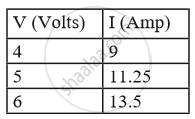
The following table shows current in Amperes and potential difference in Volts.
Which law will the graph prove? Explain the law.
Explain why potential difference is always less than the e.m.f. of a cell?
An electric bulb draws 0.5 A current at 3.0 V. Calculate the resistance of the filament of the bulb.
A boy records that 4000 joules of work are required to transfer 10 coulombs of charge between two points of a resistor of 50 Ω. The current passing through it is:
What is the measure of the work done on the unit positive charge to bring it to that point against all electrical forces?
Inside a hollow charged spherical conductor, the potential ______
