Advertisements
Advertisements
प्रश्न
Advertisements
उत्तर
The rate of movement of charge from one point to another through a section of the conductor is called electric current. Current refers to rate of flow of charges in a conductor.
I = Q/t
संबंधित प्रश्न
Three 2 V cells are connected in series and used as a battery in a circuit.
- What is the p.d. at the terminals of the battery?
- How many joules of electrical energy does 1 C gain on passing through
- one cell
- all three cells?
If a charge of 420 C flows through a conducting wire in 5 minutes what is the value of the current?
The diagram shows two ways of connecting three lamps P, Q and R to A.C. supply of 220 V.
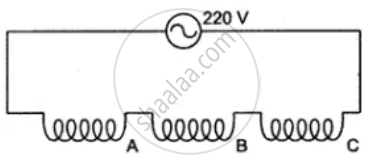
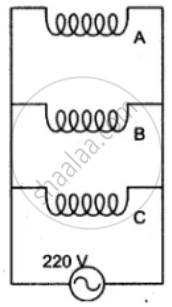
At the time of short circuit, the electric current in the circuit ______.
State the conditions for the flow of charge in a circuit from one point to the other.
Three resistances, of which two are equal when connected in series have an effective resistance of 30 ohms. When the three resistances are connected in parallel, the effective resistances is 3 ohms. Find the values of the individual resistances.
The number of electrons required to produce a total charge of 1.6 C is:
