Advertisements
Advertisements
प्रश्न
Three 2 V cells are connected in series and used as a battery in a circuit.
- What is the p.d. at the terminals of the battery?
- How many joules of electrical energy does 1 C gain on passing through
- one cell
- all three cells?
Advertisements
उत्तर
a. If three cells of 2 volts each are connected in series to make a battery, then the total potential difference between the terminals of the battery will be 6 V.
b. i. Given: p.d. = 2 V
Charged moved = 1 C
We know that,
Work done = p.d. × charge moved
Work done = 2 × 1
Work done = 2 joules
ii. Given: p.d. = 6 V
Charge moved = 1 C
We know that,
Work done = p.d. × charge moved
Work done = 6 × 1
Work done = 6 joules
APPEARS IN
संबंधित प्रश्न
Which of the two is connected in series : ammeter or voltmeter?
What is the current in a circuit if the charge passing each point is 20 C in 40 s?
Why should the resistance of:
a voltmeter be very large?
Three resistors are connected as shown in the diagram.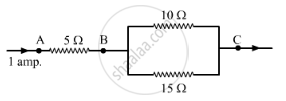
Through the resistor 5 ohm, a current of 1 ampere is flowing.
(i) What is the current through the other two resistors?
(ii) What is the p.d. across AB and across AC?
(iii) What is the total resistance
What happens to the other bulbs in a series circuit if one bulb blows off?
Ten bulbs are connected in a series circuit to a power supply line. Ten identical bulbs are connected in a parallel circuit to an identical power supply line.
(b) In which circuit, if one bulbs be brighter?
A wire of uniform thickness with a resistance of 27Ω is cut into three equal pieces and they are joined in parallel. Find the equivalent resistance of the parallel combination.
The diagram shows two ways of connecting three lamps P, Q and R to A.C. supply of 220 V.
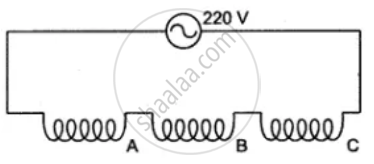
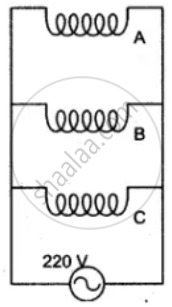
If a fuse contains a 5 A fuse wire and the voltage is 240 V, what is the maximum power (wattage) which may be taken from the circuit?
Electrical appliances have voltage and power ratings as listed below. Which
has the larger working resistance?
| Appliances | Voltage (V) | Power (W) |
| (a) Washing machine | 250 | 3000 |
| ( b) Television | 240 | 160 |
| (c)240 | 240 | 1500 |
| ( d) Hair curler | 250 | 20 |
| ( e) Car head lamp | 12 | 36 |
An electric bulb is rated '100 W, 250 V'. How much current will the bulb draw if connected to a 250 V supply?
An electric bulb is rated at 220 V, 100 W.
- What is its resistance?
- What safe current can be passed through it?
State whether the following statement is True or False:
The SI unit of charge is the coulomb.
Electric current passes through a metallic conductor due to the movement of ______.
Electrons in a conductor move from:
In a vacuum, the particles that can act as charge carriers are:
