Advertisements
Advertisements
प्रश्न
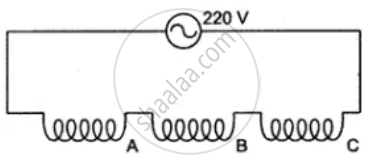
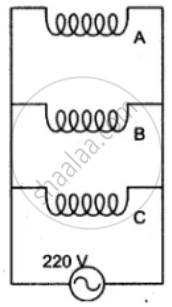
The diagram shows two ways of connecting three lamps P, Q and R to A.C. supply of 220 V.
Advertisements
उत्तर
The arrangement is shown in the figure (i) is a series arrangement. The arrangement in figure (ii) is the parallel arrangement.
We prefer a parallel arrangement. The reasons are:
(i) In series arrangement, if one of the bulbs is fused, the other bulbs also cease to glow. But in a parallel arrangement, if one bulb fuses, the other bulbs continue to glow.
(ii) In the series arrangement, while one bulb glows if the other bulb is switched on, the resistance of the circuit increases, and hence the bulbs glow less bright. But in a parallel arrangement, each bulb glows at the same voltage, therefore the glow of a bulb is unaffected if another bulb is switched on.
APPEARS IN
संबंधित प्रश्न
What is the conventional direction of the flow of electric current? How does it differ from the direction of flow electrons?
If the current through a floodlamp is 5 A, what charge passed in 10 seconds?
(a) 0.5 C
(b) 2 C
(c) 5 C
(d) 50 C
Two lamps, one rated 40 W at 220 V and the other 60 W at 220 V, are connected in parallel to the electric supply at 220 V.
(a) Draw a circuit diagram to show the connections.
(b) Calculate the current drawn from the electric supply.
(c) Calculate the total energy consumed by the two lamps together when they operate for one hour.
Name two effects produced by electric current.
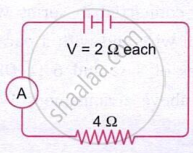
Two cells each having an e.m.f. of 2 V and an internal resistance of \(2,\Omega\) are connected in series as shown in Fig. What is the current flowing through the circuit in each case?
Match the items in column-I to the items in column-II:
| Column - I | Column - II | ||
| (i) | electric current | (a) | volt |
| (ii) | potential difference | (b) | ohm meter |
| (iii) | specific resistance | (c) | watt |
| (iv) | electrical power | (d) | joule |
| (v) | electrical energy | (e) | ampere |
The SI unit of electric current is:
Which of the following is the example expression for Alternating Current?
