Advertisements
Advertisements
प्रश्न
Match the items in column-I to the items in column-II:
| Column - I | Column - II | ||
| (i) | electric current | (a) | volt |
| (ii) | potential difference | (b) | ohm meter |
| (iii) | specific resistance | (c) | watt |
| (iv) | electrical power | (d) | joule |
| (v) | electrical energy | (e) | ampere |
Advertisements
उत्तर
| Column - I | Column - II | ||
| (i) | electric current | (e) | ampere |
| (ii) | potential difference | (a) | volt |
| (iii) | specific resistance | (b) | ohm meter |
| (iv) | electrical power | (c) | watt |
| (v) | electrical energy | (d) | joule |
APPEARS IN
संबंधित प्रश्न
Using the circuit given below, state which of the following statement is correct?
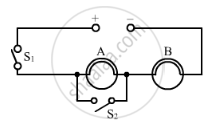
(a) When S1 and S2 are closed, lamps A and B are lit.22
(b) With S1 open and S2 closed, A is lit and B is not lit.
(c) With S2 open and S1 closed A and B are lit.
(d) With S1 closed and S2 open, lamp A remains lit even if lamp B gets fused.
A cell supplies a current of 1.2 A through two 2 Ω resistors connected in parallel. When the resistors are connected in series, it supplies a current of 0.4 A. Calculate:
(i) the internal resistance and (ii) e.m.f. of the cell.
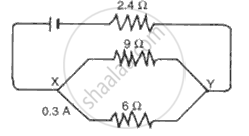
A current of 0.3 A is flowing through a branch of 6 Ω resistors in a junction as shown in fig. . Calculate the
(a) P.d. across the junction XY,
(b) Current flowing through 9Ω and 24Ω
( c) P.d. across 24 Ω resistor, and
( d) e.m.f. of the cell.
What is the speed of electric current?
The SI unit for electric current is the coulomb.
What is the rate at which charges flow past a point on a circuit?
The magnitude of Alternating Current (AC):
