Advertisements
Advertisements
प्रश्न
Match the items in column-I to the items in column-II:
| Column - I | Column - II | ||
| (i) | electric current | (a) | volt |
| (ii) | potential difference | (b) | ohm meter |
| (iii) | specific resistance | (c) | watt |
| (iv) | electrical power | (d) | joule |
| (v) | electrical energy | (e) | ampere |
Advertisements
उत्तर
| Column - I | Column - II | ||
| (i) | electric current | (e) | ampere |
| (ii) | potential difference | (a) | volt |
| (iii) | specific resistance | (b) | ohm meter |
| (iv) | electrical power | (c) | watt |
| (v) | electrical energy | (d) | joule |
APPEARS IN
संबंधित प्रश्न
In 10 s, charge of 25 C leaves a battery, and 200 J of energy are delivered to an outside circuit a result.
What current flows from the battery?
Give three reasons why different electrical appliances in a domestic circuit are connected in parallel.
Ten bulbs are connected in a series circuit to a power supply line. Ten identical bulbs are connected in a parallel circuit to an identical power supply line.
(d) Which circuit would have less current in it?
An electrician has wired a house in such a way that if a lamp gets fused in one room of the house, all the lamps in other rooms of the house stop working. What is the defect in the wiring?
In the network shown in the following adjacent Figure, calculate the equivalent resistance between the points.
- A and B
- A and C

Fig . shows the core of a transformer and i ts input and output connections
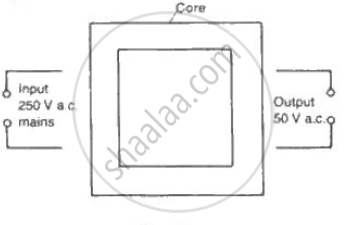
State the material used for the core and describe th e structure of the core.
(a) Use the values given in the diagram to calculate the turns ratio for the transformer and connections, labeling all parts of the diagram .
(b) If a current of 2 A is taken from th e output, calculate th e current in the input circuit (Assume the transformer to be ideal ).
State the S.I. units of electrical power.
Electric current passes through a metallic conductor due to the movement of ______.
