Advertisements
Advertisements
प्रश्न
Advertisements
उत्तर
Conductance is a measure of the ease of flow of current through a conductor. It is defined as the reciprocal of the resistance of the conductor. It is represented by C.
Mathematically,
`C = 1/R`
where R is the resistance of the conductor.
APPEARS IN
संबंधित प्रश्न
How many milliamperes as there in 1 ampere?
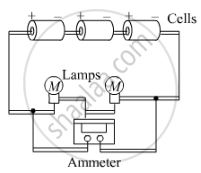
A student made an electric circuit shown here to measure the current through two lamps.
Are the lamps in series or parallel?
(a) Are the lamps in series or parallel?
(b) The student has made a mistake in this circuit. What is the mistake?
(c) Draw a circuit diagram to show the correct way to connect the circuit. Use the proper circuit symbols in your diagram.
An electrician has wired a house in such a way that if a lamp gets fused in one room of the house, all the lamps in other rooms of the house stop working. What is the defect in the wiring?
Find the potential difference required to pass a current of 0.2 A in a wire of resistance 20Ω
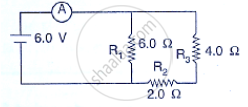
Three resistors of 6.0 𝛀, 2.0𝛀 and 4.0𝛀 are joined to an ammeter A and a cell of e.m.f. 6.0 V as
shown in fig 8.52 Calculate:
(a) the effective resistance of the circuit and
(b) the reading of ammeter.
An electric kettle has a heating element which is rated at 2 kW when connected to a 250 V electric supply. Calculate the
(a) Current which flows in the element when it is connected to a 250 V supply,
(b) Resistance of the filament,
(c) Heat produced in 1 minute by the element,
(d) Cost of running the kettle for 10 minutes a day for 30 days of the month, at the rate of Rs. 3.00 per unit.
Electric current is defined as:
The direction of Direct Current (DC) is characterized as:
