Advertisements
Advertisements
प्रश्न
Advertisements
उत्तर
The metal case of an electrical appliance is earthed so that in any case of accidental contact of live wire with the metallic body of the appliance, the earthing would provide a safe and easy path for the electric charges to flow down to the earth which acts as very large sink. Thus, user is thereby protected from any fatal electric shock.
APPEARS IN
संबंधित प्रश्न
The SI unit of charge is volt.
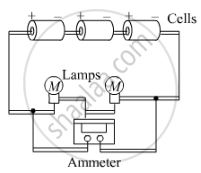
A student made an electric circuit shown here to measure the current through two lamps.
Are the lamps in series or parallel?
(a) Are the lamps in series or parallel?
(b) The student has made a mistake in this circuit. What is the mistake?
(c) Draw a circuit diagram to show the correct way to connect the circuit. Use the proper circuit symbols in your diagram.
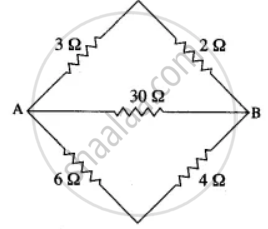
Calculate the equivalent resistance between A and B in the adjacent diagram.
Calculate the amount of energy transferred by a 10 A electric current flowing through a resistor of 5 o for 15 minutes.
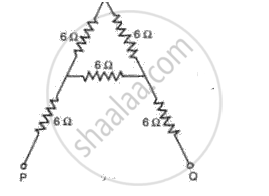
Find the effective resistance in the following circuit diagrams (Fig.):
An auto lamp is joined to a battery of e.m.f. 4 V and internal resistance 2.5Ω. A steady current of 0.5 A flows through the circuit. Calculate the
(a) Total energy provided by battery in 10 minutes,
(b) Heat dissipated in the bulb in 10 minutes.
Fig . shows the core of a transformer and i ts input and output connections
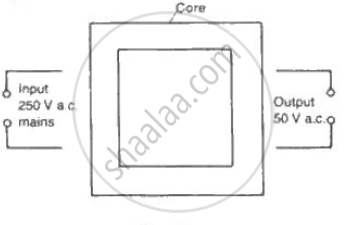
State the material used for the core and describe th e structure of the core.
(a) Use the values given in the diagram to calculate the turns ratio for the transformer and connections, labeling all parts of the diagram .
(b) If a current of 2 A is taken from th e output, calculate th e current in the input circuit (Assume the transformer to be ideal ).
Three heaters each rated 250 W, 100 V are connected in parallel to a 100 V supply. The resistance of each heater
In a vacuum, the particles that can act as charge carriers are:
