Advertisements
Advertisements
प्रश्न
Which unit could be used to measure current?
(a) Watt
(b) Coulomb
(c) Volt
(d) Ampere
Advertisements
उत्तर
Ampere
It is the SI unit of electric current.
APPEARS IN
संबंधित प्रश्न
Why should the resistance of:
an ammeter be very small?
In the circuit diagram given below five resistances of 10 Ω, 40 Ω, 30 Ω, 20 Ω, and 60 Ω are connected as shown to a 12 V battery.
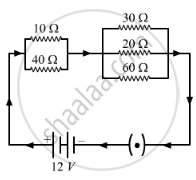
Calculate:
(a) total resistance in the circuit.
(b) total current flowing in the circuit.
In the circuit diagram given below, three resistors R1, R2, and R3 of 5 Ω, 10 Ω and 30 Ω, respectively are connected as shown
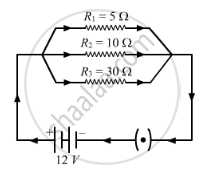
Calculate:
- current through each resistor.
- total current in the circuit.
- total resistance in the circuit.
Using the circuit given below, state which of the following statement is correct?
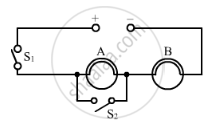
(a) When S1 and S2 are closed, lamps A and B are lit.22
(b) With S1 open and S2 closed, A is lit and B is not lit.
(c) With S2 open and S1 closed A and B are lit.
(d) With S1 closed and S2 open, lamp A remains lit even if lamp B gets fused.
Two resistors of 2.0 Ω and 3.0 Ω are connected (a) in series (b) in parallel, with a battery of 6.0 V and negligible internal resistance. For each case draw a circuit diagram and calculate the current through the battery.
Draw a schematic diagram of an electric circuit consisting of a battery of two cells each of 1.5 V, 5 Ω, 10 Ω and 15 Ω resistors and a plug key, all connected in series.
Find the effective resistance in the following circuit diagrams (Fig.):
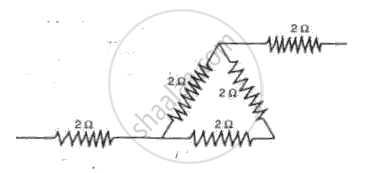
Complete the following table. The first answer has been given as an example.
| Quantity | Unit | |
| (a) | Electrical potential | volt |
| (b) | Resistance | ........ |
| (c) | Power | ........ |
| (d) | Energy | ........ |
| (e) | Resistivity | ........ |
If a fuse contains a 5 A fuse wire and the voltage is 240 V, what is the maximum power (wattage) which may be taken from the circuit?
An electric iron is rated 750 W, 230 V. Calculate the electrical energy consumed by the press in 16 hours.
Small amounts of electrical current are measured in milliampere (mA). How many milliampere are there in 0.25 A ?
Conventionally, the direction of the current is taken as:
Assertion (A): Electric current will not flow between two charged bodies when connected if their charges are the same.
Reason (R): Current is the rate of flow of charge.
What is the rate at which charges flow past a point on a circuit?
The electron was discovered in 1897 by:
The direction of Direct Current (DC) is characterized as:
