Advertisements
Advertisements
प्रश्न
Which unit could be used to measure current?
(a) Watt
(b) Coulomb
(c) Volt
(d) Ampere
Advertisements
उत्तर
Ampere
It is the SI unit of electric current.
APPEARS IN
संबंधित प्रश्न
Define the unit of current.
If the charge on an electron is 1.6 × 10⁻¹⁹ coulombs, how many electrons should pass through a conductor in 1 second to constitute 1 ampere current?
Which instrument is used to measure electric current? How should it be connected in a circuit?
Give three reasons why different electrical appliances in a domestic circuit are connected in parallel.
State two differences between the e.m.f. and terminal voltage of a cell.
The following table shows the current in Amperes and potential differences in Volts.
- Find the average resistance.
- What will be the nature of the graph between the current and potential difference? (Do not draw a graph.)
- Which law will the graph prove? Explain the law.
| V (volts) | I (amp) |
| 4 | 9 |
| 5 | 11.25 |
| 6 | 13.5 |
Two resistors of 4 Ω and 6 Ω are connected in parallel. The combination is
connected across a 6 volt battery of negligible resistance. Calculate:
( i) The power supplied by the battery,
(ii) The power dissipated in each resistor.
Define the following:
Semiconductors
What would be the danger involved in replacing a blown fuse with the one which would carry a large current?
Answer the following question.
An electric lamp of resistance 20 Ω and a conductor of resistance 4 0 are connected to a 6 V battery as shown in the circuit. Calculate: 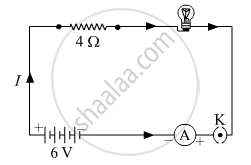
(a) the total resistance of the circuit,
(b) the current through the circuit,
(c) the potential difference across the (i) electric lamp and (ii) conductor, and
(d) power of the lamp.
State the condition when it is advantageous to connect cells in series.
Which part of an electrical appliance is earthed?
The flow of electric charge per unit time is called potential difference.
Match the following:
| 1. | 1 mA | a. | series |
| 2. | 1 pA | b. | ohmmeter |
| 3. | Ammeter | c. | 10-6 ampere |
| 4. | Electrical resistivity | d. | 10-3 ampere |
The magnitude of Alternating Current (AC):
Common sources of Alternating Current (AC) are:
The RMS value of AC is defined as:
