Advertisements
Advertisements
प्रश्न
In the network shown in the following adjacent Figure, calculate the equivalent resistance between the points.
- A and B
- A and C

Advertisements
उत्तर
(a) Rs = r1 + r2 + r3
Rs = 2 + 2 + 2
Rs = 6 Ω
`"R"_1` and `"R"_2` are connected in parallel
`1/"R"=1/"R"_"s"+1/"r"_4 = 1/6 + 1/2 = 4/6 " i.e." 2/3`
R = `3/2`
R = 1.5 Ω
(b) `"R"_("s"_1) = "r"_1 + "r"_2`
`"R"_("s"_1)` = 2 + 2 = 4 Ω
`"R"_("s"_2)` = r3 + r4 = 2 + 2 = 4 Ω
`"R"_1` and `"R"_2` are connected in parallel
`1/"R" =1/"R"_("s"_1) + 1/"R"_("s"_2)`
`1/"R" = 1/4 + 1/4`
`1/"R" = 2/4 ~~ 1/2`
R = 2 Ω
APPEARS IN
संबंधित प्रश्न
<p> Define the unit of electric current (or Define ampere).
The circuit diagram given below shows the combination of three resistors R1, R2 and R3:
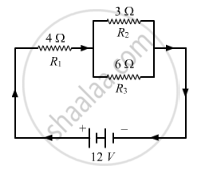
Find :
(i) total resistance of the circuit.
(ii) total current flowing in the circuit.
(iii) the potential difference across R1.
Which is the better way to connect lights and other electrical appliances in domestic wiring: series circuits or parallel circuits? why?
Draw a circuit diagram showing two lamps, one cell and a switch connected in series.
How can you change the brightness of the lamp?
An electric current flowing in a wire creates ______ around the wire.
A bulb marked 12 V, 24 W operates on a 12 volt car battery for 20 minutes. Calculate:
(i) The current flowing through it, and
(ii) The energy liberated.
Assertion (A): Electric current will not flow between two charged bodies when connected if their charges are the same.
Reason (R): Current is the rate of flow of charge.
By convention, the direction of electric current in the external circuit is taken as:
In ionised gases (plasma), the charge carriers are:
Common sources of Alternating Current (AC) are:
