Advertisements
Advertisements
प्रश्न
What is an electric current?
Advertisements
उत्तर
An electric current is the flow of electric charge called electrons in a conductor and its magnitude is the amount of electric charge passing through a given point of the conductor in one second.
APPEARS IN
संबंधित प्रश्न
Three 2 V cells are connected in series and used as a battery in a circuit.
- What is the p.d. at the terminals of the battery?
- How many joules of electrical energy does 1 C gain on passing through
- one cell
- all three cells?
A current of 4 A flows around a circuit for 10 s. How much charge flows past a point in the circuit in this time?
What is the current in a circuit if the charge passing each point is 20 C in 40 s?
What Makes an Electric Current Flow in a Wire?
If the charge on an electron is 1.6 × 10⁻¹⁹ coulombs, how many electrons should pass through a conductor in 1 second to constitute 1 ampere current?
If the current through a floodlamp is 5 A, what charge passed in 10 seconds?
(a) 0.5 C
(b) 2 C
(c) 5 C
(d) 50 C
The p.d. across a 3 Ω resistor is 6 V. The current flowing in the resistor will be:
(a) `1/2A`
(b) 1 A
(c) 2 A
(d) 6 A
An electric bulb of resistance 20 Ω and a resistance wire of 4 Ω are connected in series with a 6 V battery.
Draw the circuit diagram, and calculate:
(a) total resistance of the circuit.
(b) current through the circuit.
(c) potential difference across the electric bulb.
(d) potential difference across the resistance wire.
Consider the circuit given below:
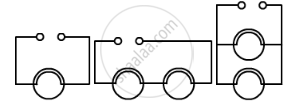
(a) In which circuit are the lamps dimmest?
(b) In which circuit or circuits are the lamps of equal brightness to the lamps in circuit (i)?
(c) Which circuit gives out the maximum light?
If you were going to connect two light bulbs to one battery, would you use a series or a parallel arrangement? Why? Which arrangement takes more current from the battery?
Find the effective resistance in the following circuit diagrams (Fig.):
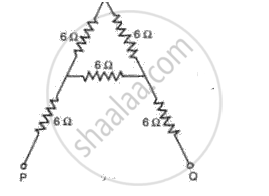
A bulb of 40 W is used for 12.5 h each day for 30 days. Calculate the electrical energy consumed.
An electrical appliance is rated at 1000 KVA, 220V. If the appliance is operated for 2 hours, calculate the energy consumed by the appliance in: (i) kWh (ii) joule.
Coulomb is the SI unit of ____________.
Which of the following represents voltage?
In metallic conductors, the charge carriers responsible for producing electric current are:
In ionised gases (plasma), the charge carriers are:
