Advertisements
Advertisements
प्रश्न
If you were going to connect two light bulbs to one battery, would you use a series or a parallel arrangement? Why? Which arrangement takes more current from the battery?
Advertisements
उत्तर
Since every lightbulb in a parallel circuit receives the same voltage as the battery, I would choose to utilize a parallel arrangement. Additionally, if a flaw causes one light to stop glowing, the other bulb keeps glowing. This guarantees that even in the event of a single bulb failure, the circuit will continue to function. Because the parallel design has a lower equivalent resistance than a series arrangement, it pulls more current from the battery. Ohm's Law (I = V/R) states that a stronger current from the same voltage source is produced by a lower resistance.
APPEARS IN
संबंधित प्रश्न
What does an electric circuit mean?
Which of the following units could be used to measure electric charge?
(a) ampere
(b) joule
(c) volt
(d) coulomb
State the factors on which the strength of electric current flowing in a given conductor depends.
The circuit diagram given below shows the combination of three resistors R1, R2 and R3:
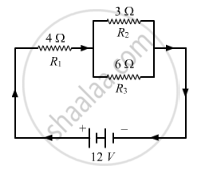
Find :
(i) total resistance of the circuit.
(ii) total current flowing in the circuit.
(iii) the potential difference across R1.
The figure given below shows an electric circuit in which current flows from a 6 V battery through two resistors.
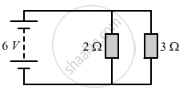
- Are the resistors connected in series with each other or in parallel?
- For each resistors, state the p.d. across it.
- The current flowing from the battery is shared between the two resistors. Which resistor will have bigger share of the current?
- Calculate the effective resistance of the two resistors.
- Calculate the current that flows from the battery.
Draw a circuit diagram showing two lamps, one cell and a switch connected in series.
How can you change the brightness of the lamp?
Consider the circuit given below when A, B and C are three identical light bulbs of constant resistance. 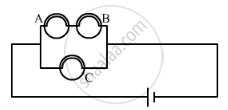
(a) List the bulbs in order of increasing brightness.
(b) If C burns out, what will be the brightness of A now compared with before?
(c) If B burns out instead, what will be the brightness of A and C compared with before?
A 720 W heater operates from a 220 V line voltage. Calculate:
(a) The electrical energy consumed by the heater in 3 h.
(b) The cost of electrical energy consumption at the rate of 60 paise per kWh.
The diagram shows two ways of connecting three lamps P, Q and R to A.C. supply of 220 V.
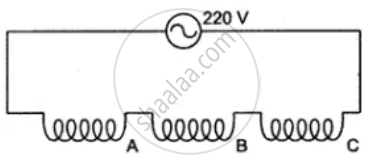
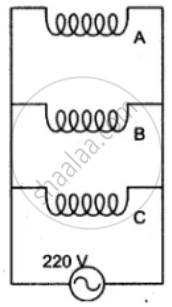
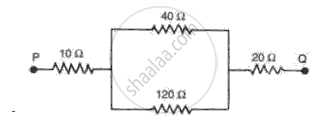
Find the effective resistance in the following circuit diagrams (Fig.):
Calculate the current through a 60 W lamp rated 250 V. If the line voltage falls to 200 V, how is power consumed by the bulb affected?
At the time of short circuit, the electric current in the circuit ______.
State the condition when it is advantageous to connect cells in parallel.
Electric current passes through a metallic conductor due to the movement of ______.
Assertion (A): Electric current will not flow between two charged bodies when connected if their charges are the same.
Reason (R): Current is the rate of flow of charge.
The relationship between conventional current and electron flow is that they are:
In ionised gases (plasma), the charge carriers are:
