Advertisements
Advertisements
प्रश्न
If you were going to connect two light bulbs to one battery, would you use a series or a parallel arrangement? Why? Which arrangement takes more current from the battery?
Advertisements
उत्तर
Since every lightbulb in a parallel circuit receives the same voltage as the battery, I would choose to utilize a parallel arrangement. Additionally, if a flaw causes one light to stop glowing, the other bulb keeps glowing. This guarantees that even in the event of a single bulb failure, the circuit will continue to function. Because the parallel design has a lower equivalent resistance than a series arrangement, it pulls more current from the battery. Ohm's Law (I = V/R) states that a stronger current from the same voltage source is produced by a lower resistance.
APPEARS IN
संबंधित प्रश्न
What is the Flow of Charge Called?
Why should the resistance of:
a voltmeter be very large?
In the circuit shown below, the voltmeter reads 10 V.
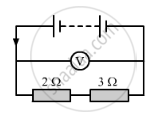
(a) What is the combined resistance?
(b) What current flows?
(c) What is the p.d. across 2 Ω resistor?
(d) What is the p.d. across 3 Ω resistor?
V1, V2 and V3 are the p.ds. across the 1Ω, 2Ω and 3Ω resistors in the following diagram, and the current is 5 A.
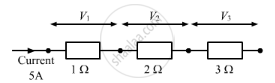
Which one of the columns (a) to (d) shows the correct values of V1, V2 and V3measured in volts?
`V_1` `V_2` `V_3`
(a) 1.0 2.0 3.0
(b) 5.0 10.0 15.0
(c) 5.0 2.5 1.6
(d) 4.0 4.0 2.0
Draw a circuit diagram to show how two 4 V electric lamps can be lit brightly from two 2 V cells.
How do you think the brightness of two lamps arranged in parallel compares with the brightness of two lamps arranged in series (both arrangements having one cell)?
Match the pairs.
| ‘A’ Group | ‘B’ Group |
| 1. Free electrons | a. V/R |
| 2. Current | b. Increases the resistance in the circuit |
| 3. Resistivity | c. Weakly attached |
| 4. Resistances in series | d. VA/LI |
Complete the following sentence:
Fuse wire has a ............ Melting point and it is made of an alloy of ......... and if the current in a circuit rises too high, the fuse wire ...........
Calculate the amount of energy transferred by a 10 A electric current flowing through a resistor of 5 o for 15 minutes.
A bulb marked 12 V, 24 W operates on a 12 volt car battery for 20 minutes. Calculate:
(i) The current flowing through it, and
(ii) The energy liberated.
A charge of 80 C flows in a conductor for 2 minutes.
(a) Calculate the current flowing through the conductor.
(b) If the current through a heater is 4 A what charge must be passing in 8 seconds?
Two resistors P and Q of the same material and length but of different thickness are connected in parallel to a battery. The cross- sectional area of P is twice that of Q. What is the ratio of
(a) The resistance of P to the resistance of Q?
(b) The current in P to the current in Q?
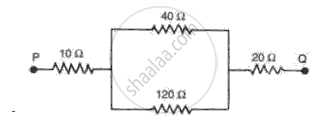
Find the effective resistance in the following circuit diagrams (Fig.):
Explain with the help of a diagram how does 'short circuiting' occur in an electric kettle.
What should I choose ___________________
b. for getting protection from electric current.
c. to measure the current in the circuit?
A current of 2A passing through the conductor produces 80 J of heat in 10 seconds. The resistance of the conductor is ______.
Common sources of Alternating Current (AC) are:
What happens when the switch in a circuit is turned OFF (open circuit)?
