Advertisements
Advertisements
प्रश्न
Which is the better way to connect lights and other electrical appliances in domestic wiring: series circuits or parallel circuits? why?
Advertisements
उत्तर
Parallel circuits – Because if one electrical appliance stops working due to some defect, then all other appliances in the circuit will keep working properly.
APPEARS IN
संबंधित प्रश्न
1 A = _________ mA
- 102
- 103
- 10-3
- 10-6
In which direction do electrons flow?
How many milliamperes as there in 1 ampere?
One coulomb of charge flows through any cross-section of a conductor in 1 second. What is the current flowing through the conductor?
The p.d. across a 3 Ω resistor is 6 V. The current flowing in the resistor will be:
(a) `1/2A`
(b) 1 A
(c) 2 A
(d) 6 A
A p.d. of 6 V is applied to two resistors of 3 Ω and 6 Ω connected in parallel. Calculate:
(a) the combined resistance
(b) the current flowing in the main circuit
(c) the current flowing in the 3 Ω resistor.
For a heater rated at 4 kW and 220 V, calculate:
(a) the current,
(b) the resistance of the heater,
(c) the energy consumed in 2 hours, and
(d) the cost if 1 kWh is priced at Rs 4.60.
The rating of a fuse connected in the lighting circuit is ______.
Find the effective resistance in the following circuit diagrams (Fig.):
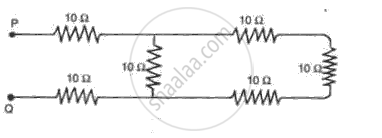
An electric iron is rated 750 W, 230 V. Calculate the electrical energy consumed by the press in 16 hours.
A current of 0.2 A flows through a wire whose ends are at a potential difference of 15 V. Calculate:
(i) The resistance of the wire, and
(ii) The heat energy produced in 1 minute.
A battery of e.m.f. 15 V and internal resistance 2 Ω is connected to two resistors of resistances 4 ohm and 6 ohm joined (a) in series. Find in each case the electrical energy spent per minute in 6 Ω resistor.
What is meant by internal resistance of a cell?
Electric current is defined as:
Electrons in a conductor move from:
In ionised gases (plasma), the charge carriers are:
