Advertisements
Advertisements
Question
Which is the better way to connect lights and other electrical appliances in domestic wiring: series circuits or parallel circuits? why?
Advertisements
Solution
Parallel circuits – Because if one electrical appliance stops working due to some defect, then all other appliances in the circuit will keep working properly.
APPEARS IN
RELATED QUESTIONS
The work done in moving a unit charge across two points in an electric circuit is a measure of ______.
In which direction do electrons flow?
In 10 s, charge of 25 C leaves a battery, and 200 J of energy are delivered to an outside circuit a result.
What current flows from the battery?
Two lamps, one rated 40 W at 220 V and the other 60 W at 220 V, are connected in parallel to the electric supply at 220 V.
(a) Draw a circuit diagram to show the connections.
(b) Calculate the current drawn from the electric supply.
(c) Calculate the total energy consumed by the two lamps together when they operate for one hour.
An electric bulb is rated as 10 W, 220 V. How many of these bulbs can be connected in parallel across the two wires of 220 V supply line if the maximum current which can be drawn is 5 A?
Tick(✓) the correct choice in the following:
24 watt, 12 volt head lamp is fully lit by connecting it to a 12 volt
battery. The working resistance of the lamp is
Define the following:
Semiconductors
What is the purpose of a fuse in an electrical circuit?
Electrical appliances have voltage and power ratings as listed below. Which
has the larger working resistance?
| Appliances | Voltage (V) | Power (W) |
| (a) Washing machine | 250 | 3000 |
| ( b) Television | 240 | 160 |
| (c)240 | 240 | 1500 |
| ( d) Hair curler | 250 | 20 |
| ( e) Car head lamp | 12 | 36 |
A battery of e.m.f. 15 V and internal resistance 2 Ω is connected to two resistors of resistances 4 ohm and 6 ohm joined (a) in series. Find in each case the electrical energy spent per minute in 6 Ω resistor.
Fill in the blank :
1 mA = ............................. A.
Answer the following question.
An electric lamp of resistance 20 Ω and a conductor of resistance 4 0 are connected to a 6 V battery as shown in the circuit. Calculate: 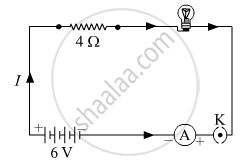
(a) the total resistance of the circuit,
(b) the current through the circuit,
(c) the potential difference across the (i) electric lamp and (ii) conductor, and
(d) power of the lamp.
What is the speed of electric current?
Match the items in column-I to the items in column-II:
| Column - I | Column - II |
| (i) electric current | (a) volt |
| (ii) potential difference | (b) ohm meter |
| (iii) specific resistance | (c) watt |
| (iv) Electrical power | (d) joule |
| (v) electrical energy | (e) ampere |
