Advertisements
Advertisements
प्रश्न
Which is the better way to connect lights and other electrical appliances in domestic wiring: series circuits or parallel circuits? why?
Advertisements
उत्तर
Parallel circuits – Because if one electrical appliance stops working due to some defect, then all other appliances in the circuit will keep working properly.
APPEARS IN
संबंधित प्रश्न
One coulomb charge is equivalent to the charge contained in:
(a) 2.6 × 10¹⁹ electrons
(b) 6.2 × 10¹⁹ electrons
(c) 2.65 × 10¹⁸ electrons
(d) 6.25 × 10¹⁸ electrons
Three resistors are connected as shown in the diagram.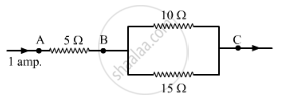
Through the resistor 5 ohm, a current of 1 ampere is flowing.
(i) What is the current through the other two resistors?
(ii) What is the p.d. across AB and across AC?
(iii) What is the total resistance
A wire of length 5 m has a resistance of 2.0 Ω calculate:
(a) the resistance of wire of length 1 m
(b) the equivalent resistance if two such wires each of length 2 m are joined in parallel.
(c) the resistance of 1 m length of wire of same material but of half diameter.
Complete the following sentence:
A fuse is connected in ........... with the ......... wire.
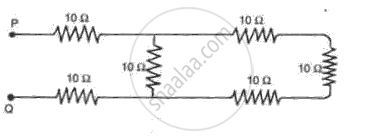
Find the effective resistance in the following circuit diagrams (Fig.):
Fill in the blank :
1 mA = ............................. A.
My mother was operating washing machine on Sunday morning. Suddenly, she saw a spark coming out of the electric board and the electric current in the house failed. An electrician was called to look into the matter. What should he have noticed.
Explain, why the potential difference across the terminals of a cell is more when the cell is not in use than it is when the cell is being used.
An electrical appliance is rated at 1000 KVA, 220V. If the appliance is operated for 2 hours, calculate the energy consumed by the appliance in: (i) kWh (ii) joule.
When an electric current is passed, electrons move from:
Define the following:
Conventional current
What does the direction of current convey?
The SI unit of electric current is:
The value used for practical measurement of Alternating Current is the:
