Advertisements
Advertisements
Question
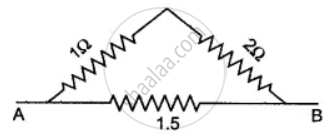
Calculate the effective resistance between the points A and B in the network shown below in Figure 8.45
Advertisements
Solution
In the diagram, 2Ω and 1Ω resistances are in series. The equivalent resistance of the arm R' = 2 + 1 = 3 Ω
Between the points A and B, the equivalent resistance R' (= 3 Ω) is in parallel with 1.5 Ω
Hence, total effective resistance between A and B is
R = `(3 xx 1.5)/(3 + 1.5) = 4.5/4.5 = 1.0 Ω`
RELATED QUESTIONS
What is the Flow of Charge Called?
An electric current flowing in a wire creates ______ around the wire.
An electric oven is rated as 1.5 kW, 250 V. If it is connected to a 250 V mains, calculate the
(a) Current drawn,
(b) Energy consumed in 20 hours,
(c) Cost of energy consumed in 20 hours at the rate of Re. 1 per unit.
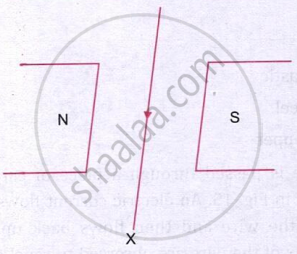
In fig. XY is at right angles to the magnetic field. The direction in which XY should be moved to induce an electron flow in the direction Y to X as indicated by the arrow is:
A current of 0.2 A flows through a wire whose ends are at a potential difference of 15 V. Calculate:
(i) The resistance of the wire, and
(ii) The heat energy produced in 1 minute.
Which of the following is the example expression for Alternating Current?
