Advertisements
Advertisements
Question
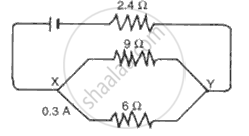
A current of 0.3 A is flowing through a branch of 6 Ω resistors in a junction as shown in fig. . Calculate the
(a) P.d. across the junction XY,
(b) Current flowing through 9Ω and 24Ω
( c) P.d. across 24 Ω resistor, and
( d) e.m.f. of the cell.
Advertisements
Solution
(a) Potential difference across XY = pot. cliff. across 6 Ω resistor
= 0.3 x 6=1.8V
b) Pot. difference across 9Ω resistor= pot. cliff. across 6 Ω resistor= 1.8 V
:. Current through 9Ω resistor = `1.8/9` = 0.2A
Current through 2.4Ω resistor = total current in the circuit = 0.3 + 0.2 = 0.5A
(c) p.d. across 2.4Ω resistor = 0.5 x 2.4 = 1.2 V
(d) emf of cell = p.d across 2.4Ω resistor+ pot cliff. across XY = 1.2 + 1.8 = 3.0 V
APPEARS IN
RELATED QUESTIONS
In which direction do electrons flow?
A flash of lighting carries 10 C of charge which flows for 0.01 s. What is the current? If the voltage is 10 MV, what is the energy?
Which is the better way to connect lights and other electrical appliances in domestic wiring: series circuits or parallel circuits? why?
Two resistors of 2.0 Ω and 3.0 Ω are connected (a) in series (b) in parallel, with a battery of 6.0 V and negligible internal resistance. For each case draw a circuit diagram and calculate the current through the battery.
A 720 W heater operates from a 220 V line voltage. Calculate:
(a) The electrical energy consumed by the heater in 3 h.
(b) The cost of electrical energy consumption at the rate of 60 paise per kWh.
Complete the following sentence:
Fuse wire has a ............ Melting point and it is made of an alloy of ......... and if the current in a circuit rises too high, the fuse wire ...........
Explain with the help of a diagram how does 'short circuiting' occur in an electric kettle.
Explain, why the potential difference across the terminals of a cell is more when the cell is not in use than it is when the cell is being used.
True or False – If False give the correct answer
The representation of the electric current is A
What is the SI unit for the current?
