Advertisements
Advertisements
प्रश्न
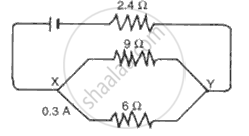
A current of 0.3 A is flowing through a branch of 6 Ω resistors in a junction as shown in fig. . Calculate the
(a) P.d. across the junction XY,
(b) Current flowing through 9Ω and 24Ω
( c) P.d. across 24 Ω resistor, and
( d) e.m.f. of the cell.
Advertisements
उत्तर
(a) Potential difference across XY = pot. cliff. across 6 Ω resistor
= 0.3 x 6=1.8V
b) Pot. difference across 9Ω resistor= pot. cliff. across 6 Ω resistor= 1.8 V
:. Current through 9Ω resistor = `1.8/9` = 0.2A
Current through 2.4Ω resistor = total current in the circuit = 0.3 + 0.2 = 0.5A
(c) p.d. across 2.4Ω resistor = 0.5 x 2.4 = 1.2 V
(d) emf of cell = p.d across 2.4Ω resistor+ pot cliff. across XY = 1.2 + 1.8 = 3.0 V
APPEARS IN
संबंधित प्रश्न
1 A = _________ mA
- 102
- 103
- 10-3
- 10-6
Calculate the number of electrons constituting one coulomb of charge.
If the amount of electric charge passing through a conductor in 10 minutes is 300 C, the current flowing is:
(a) 30 A
(b) 0.3 A
(c) 0.5 A
(d) 5 A
Which type of circuit, series or parallel, is preferred while connecting a large number of bulbs:
(b) for lighting inside the rooms of the hotel?
For a heater rated at 4 kW and 220 V, calculate:
(a) the current,
(b) the resistance of the heater,
(c) the energy consumed in 2 hours, and
(d) the cost if 1 kWh is priced at Rs 4.60.
An electric current flowing in a wire creates ______ around the wire.
The work done in moving unit positive charge across two points in an electric circuit is a measure of
Small amounts of electrical current are measured in milliampere (mA). How many milliampere are there in 0.25 A ?
The relationship between conventional current and electron flow is that they are:
