Advertisements
Advertisements
प्रश्न
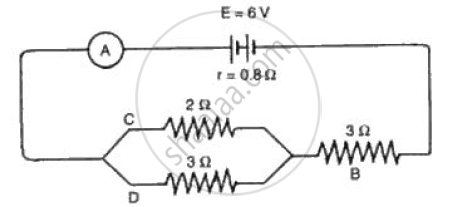
The circuit diagram (Fig.) shows a battery of e.m.f. 6 volts and internal
resistance of 0.8 Ω oonnected in series. Find the
(a) Current reoorded by the ammeter,
(b) P.d. across the terminals of the resistor B,
( c) Current passing through each of the resistors B, C and D, and
( d) P.d. across the terminals of the battery.
Advertisements
उत्तर
Given, emf e = 6 V, internal resistance r = 0.8Ω
In the given circuit, parallel combination of resistances 2Ω and 3Ω
is connected in series with a 3Ω resistance.
Resistance in parallel, `1/"R"_"p" = 1/2 + 1/3 = 5/6` Ω
Rp = 1.2 Ω
Total resistance of the given circuit, Rt= 0.8 + 3 + 1.2 = 5Ω
current recorded by the ammeter, I = `"e"/"R"_"t" = 6/5 = 1.2 "A"`
(b) P.d. across resistor B = 1.2 x 3 = 3.6 V
(c) Current passing through resistor B = 1. 2 A
Current through resistor C = `("I" xx 3)/ (2 + 3) = (1.2 xx 3)/5 = 0.72 "A"`
Current through resistor D = `("I" xx 2)/2 + 3 = (1.2 xx 2)/5 = 0.48 "A"`
(d) p.d. across the terminals of battery= 1.2 x 0.8 = 0.96 V
APPEARS IN
संबंधित प्रश्न
Which statement/statement is/are correct?
1. An ammeter is connected in series in a circuit and a voltmeter is connected in parallel.
2. An ammeter has a high resistance.
3. A voltmeter has a low resistance.
(a) 1, 2, 3
(b) 1, 2
(c) 2, 3
(d) 1
V1, V2 and V3 are the p.ds. across the 1Ω, 2Ω and 3Ω resistors in the following diagram, and the current is 5 A.
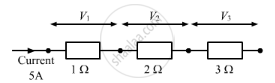
Which one of the columns (a) to (d) shows the correct values of V1, V2 and V3measured in volts?
`V_1` `V_2` `V_3`
(a) 1.0 2.0 3.0
(b) 5.0 10.0 15.0
(c) 5.0 2.5 1.6
(d) 4.0 4.0 2.0
Ten bulbs are connected in a series circuit to a power supply line. Ten identical bulbs are connected in a parallel circuit to an identical power supply line.
- Which circuit would have the highest voltage across each bulb?
- In which circuit would the bulbs be brighter?
- In which circuit, if one bulb blows out, all others will stop glowing?
- Which circuit would have less current in it?
An auto lamp is joined to a battery of e.m.f. 4 V and internal resistance 2.5Ω. A steady current of 0.5 A flows through the circuit. Calculate the
(a) Total energy provided by battery in 10 minutes,
(b) Heat dissipated in the bulb in 10 minutes.
An electric bulb is marked 100 W, 250 V. How much current will the bulb draw if connected to a 250 V supply?
- What is meant by electric current?
- Name and define its unit.
- Which instrument is used to measure the electric current? How should it be connected in a circuit?
