Advertisements
Advertisements
प्रश्न
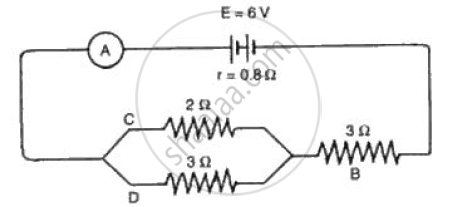
The circuit diagram (Fig.) shows a battery of e.m.f. 6 volts and internal
resistance of 0.8 Ω oonnected in series. Find the
(a) Current reoorded by the ammeter,
(b) P.d. across the terminals of the resistor B,
( c) Current passing through each of the resistors B, C and D, and
( d) P.d. across the terminals of the battery.
Advertisements
उत्तर
Given, emf e = 6 V, internal resistance r = 0.8Ω
In the given circuit, parallel combination of resistances 2Ω and 3Ω
is connected in series with a 3Ω resistance.
Resistance in parallel, `1/"R"_"p" = 1/2 + 1/3 = 5/6` Ω
Rp = 1.2 Ω
Total resistance of the given circuit, Rt= 0.8 + 3 + 1.2 = 5Ω
current recorded by the ammeter, I = `"e"/"R"_"t" = 6/5 = 1.2 "A"`
(b) P.d. across resistor B = 1.2 x 3 = 3.6 V
(c) Current passing through resistor B = 1. 2 A
Current through resistor C = `("I" xx 3)/ (2 + 3) = (1.2 xx 3)/5 = 0.72 "A"`
Current through resistor D = `("I" xx 2)/2 + 3 = (1.2 xx 2)/5 = 0.48 "A"`
(d) p.d. across the terminals of battery= 1.2 x 0.8 = 0.96 V
APPEARS IN
संबंधित प्रश्न
Calculate the number of electrons constituting one coulomb of charge.
A 5 V battery is connected to two 20 Ω resistors which are joined together in series.
(a) Draw a circuit diagram to represent this. Add an arrow to indicate the direction of conventional current flow in the circuit.
(b) What is the effective resistance of the two resistors?
(c) Calculate the current that flows from the battery?
(d) What is the p.d. across each resistor?
What happens to the other bulbs in a parallel circuit if one bulb blows off?
Give three reasons why different electrical appliances in a domestic circuit are connected in parallel.
Which effect of current is utilised in the working of an electric fuse?
Tell the odd one out. Give a proper explanation.
An electric kettle is rated 2.5 kW, 250 V. Find the cost of running the kettle for two hours at Rs. 5.40 per unit.
Define an electric current.
Kilowatt hour is the unit of
Electric current passes through a metallic conductor due to the movement of ______.
