Advertisements
Advertisements
प्रश्न
Which effect of current is utilised in the working of an electric fuse?
Advertisements
उत्तर
The heating effect of current is utilised in the working of an electric fuse.
APPEARS IN
संबंधित प्रश्न
Fill in the blank:
To increase the effective resistance in a circuit the resistors are connected in _____________.
What is the current in a circuit if the charge passing each point is 20 C in 40 s?
Which statement/statement is/are correct?
1. An ammeter is connected in series in a circuit and a voltmeter is connected in parallel.
2. An ammeter has a high resistance.
3. A voltmeter has a low resistance.
(a) 1, 2, 3
(b) 1, 2
(c) 2, 3
(d) 1
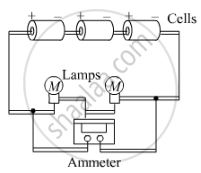
A student made an electric circuit shown here to measure the current through two lamps.
Are the lamps in series or parallel?
(a) Are the lamps in series or parallel?
(b) The student has made a mistake in this circuit. What is the mistake?
(c) Draw a circuit diagram to show the correct way to connect the circuit. Use the proper circuit symbols in your diagram.
Using the circuit given below, state which of the following statement is correct?
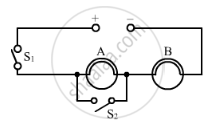
(a) When S1 and S2 are closed, lamps A and B are lit.22
(b) With S1 open and S2 closed, A is lit and B is not lit.
(c) With S2 open and S1 closed A and B are lit.
(d) With S1 closed and S2 open, lamp A remains lit even if lamp B gets fused.
If the current passing through a conductor is doubled, what will be the change in heat produced
Define the term resistivity.
A switch must be connected in ______.
A wire of length 5 m has a resistance of 2.0 Ω calculate:
(a) the resistance of wire of length 1 m
(b) the equivalent resistance if two such wires each of length 2 m are joined in parallel.
(c) the resistance of 1 m length of wire of same material but of half diameter.
An electric current flowing in a wire creates ______ around the wire.
Complete the following sentence:
A fuse is connected in ........... with the ......... wire.
Tick(✓) the correct choice in the following:
A three pin plug is connected to the lead for a 1 kW electric iron to be
used on a 250 V supply. Which of the following statements is not correct?
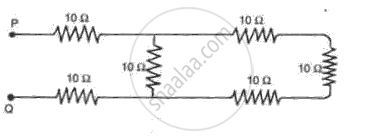
Find the effective resistance in the following circuit diagrams (Fig.):
Three heaters each rated 250 W, 100 V are connected in parallel to a 100 V supply of the energy supplied in kWh to the three heaters in 5 hours.
Give the electric current unit.
Assertion (A): Electric current will not flow between two charged bodies when connected if their charges are the same.
Reason (R): Current is the rate of flow of charge.
