Advertisements
Advertisements
प्रश्न
Calculate the number of electrons constituting one coulomb of charge.
Advertisements
उत्तर
One electron possesses a charge of 1.6 × 10⁻¹⁹C, i.e., 1.6 × 10⁻¹⁹C of charge is contained in 1 electron.
∴ 1 C of charge is contained in `1/(1.6 xx 10^(-19))`
= 6.25 × 1018
= 6 × 10¹⁸
Therefore, 6 × 10¹⁸ electrons constitute one coulomb of charge.
APPEARS IN
संबंधित प्रश्न
By what name is the physical quantity coulomb/second called?
How many electrons are flowing per second past a point in a circuit in which there is a current of 5 amp?
A battery of 9 V is connected in series with resistors of 0.2 Ω, 0.3 Ω, 0.4 Ω, 0.5 Ω and 12 Ω. How much current would flow through the 12 Ω resistor?
Which type of circuit, series or parallel, is preferred while connecting a large number of bulbs:
(a) for decorating a hotel building from outside?
Using the circuit given below, state which of the following statement is correct?
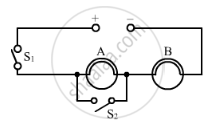
(a) When S1 and S2 are closed, lamps A and B are lit.22
(b) With S1 open and S2 closed, A is lit and B is not lit.
(c) With S2 open and S1 closed A and B are lit.
(d) With S1 closed and S2 open, lamp A remains lit even if lamp B gets fused.
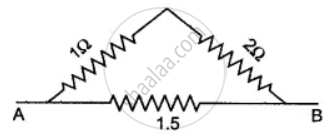
Calculate the effective resistance between the points A and B in the network shown below in Figure 8.45
Tell the odd one out. Give a proper explanation.
Explain with the help of a diagram how does 'short circuiting' occur in an electric kettle.
An electric iron is rated 750 W, 230 V. Calculate the electrical energy consumed by the press in 16 hours.
Which part of an electrical appliance is earthed?
True or False – If False give the correct answer
The representation of the electric current is A
What is the speed of electric current?
One unit of electrical energy consumed is equal to 1000 kilowatt-hour.
Conventionally, the direction of the current is taken as:
