Advertisements
Advertisements
प्रश्न
Define an electric current.
Advertisements
उत्तर १
An electric current is measured by the amount of electric charge moving per unit time at any point in the circuit.
उत्तर २
The magnitude of an electric current is the number of electric charges flowing through a conductor in one second.
APPEARS IN
संबंधित प्रश्न
In which direction do electrons flow?
How many microamperes are there in 1 ampere?
What is an Ammeter? How is It Connected in a Circuit? Draw a Diagram to Illustrate Your Answer.
State the factors on which the strength of electric current flowing in a given conductor depends.
An electric circuit consisting of a 0.5 m long nichrome wire XY, an ammeter, a voltmeter, four cells of 1.5 V each and a plug key was set up.
Following graph was plotted between V and I values:
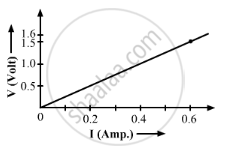
What would be the values of `V/I` rations when the potential difference is 0.8 V, 1.2 V and 1.6 V respectively?
What conclusion do you draw from these values?
What is the resistance of the wire?
How does the heat H produced by a current passing through a fixed resistance wire depend on magnitude of current I?
A switch must be connected in ______.
Find the potential difference required to pass a current of 0.2 A in a wire of resistance 20Ω
Tell the odd one out. Give a proper explanation.
A 720 W heater operates from a 220 V line voltage. Calculate:
(a) The electrical energy consumed by the heater in 3 h.
(b) The cost of electrical energy consumption at the rate of 60 paise per kWh.
Tick(✓) the correct choice in the following:
A three pin plug is connected to the lead for a 1 kW electric iron to be
used on a 250 V supply. Which of the following statements is not correct?
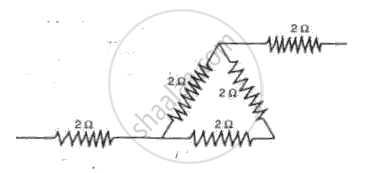
Find the effective resistance in the following circuit diagrams (Fig.):
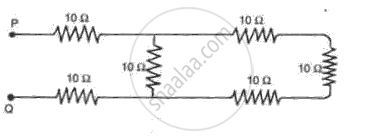
Find the effective resistance in the following circuit diagrams (Fig.):
What is the criteria for selecting a fuse wire?
An electric kettle has a heating element which is rated at 2 kW when connected to a 250 V electric supply. Calculate the
(a) Current which flows in the element when it is connected to a 250 V supply,
(b) Resistance of the filament,
(c) Heat produced in 1 minute by the element,
(d) Cost of running the kettle for 10 minutes a day for 30 days of the month, at the rate of Rs. 3.00 per unit.
1 kWh = `(1 "volt" xx 1 "ampere" xx "_________")/1000`
An electric iron is rated 750 W, 230 V. Calculate the electrical energy consumed by the press in 16 hours.
A current of 0.2 A flows through a wire whose ends are at a potential difference of 15 V. Calculate:
(i) The resistance of the wire, and
(ii) The heat energy produced in 1 minute.
At the time of short circuit, the electric current in the circuit ______.
How should the electric lamps in a building be connected?
Give the electric current unit.
Electric current is defined as:
In electrolytes such as salt solutions, the charge carriers are:
In semiconductors, the charge carriers are:
