Advertisements
Advertisements
प्रश्न
What is an Ammeter? How is It Connected in a Circuit? Draw a Diagram to Illustrate Your Answer.
Advertisements
उत्तर
An ammeter is an instrument that is used to measure electric current. It is always connected in series with the circuit in which the current is to be measured.

Suppose we want to find out the current flowing through a conductor AB. Here, we should connect the ammeter in series with the conductor AB as above.
APPEARS IN
संबंधित प्रश्न
In which direction do electrons flow?
Compare how an ammeter and a voltmeter are connected in a circuit.
If 20 C of charge pass a point in a circuit in 1 s, what current is flowing?
If the current through a floodlamp is 5 A, what charge passed in 10 seconds?
(a) 0.5 C
(b) 2 C
(c) 5 C
(d) 50 C
(a) With the help of a circuit diagram, obtain the relation for the equivalent resistance of two resistances connected in parallel.
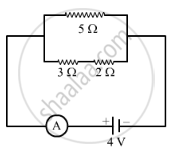
(b) In the circuit diagram shown below, find:
(i) Total resistance.
(ii) Current shown by the ammeter A
For a heater rated at 4 kW and 220 V, calculate:
(a) the current,
(b) the resistance of the heater,
(c) the energy consumed in 2 hours, and
(d) the cost if 1 kWh is priced at Rs 4.60.
State three factors on which the heat produced by an electric current depends. How does it depend on these factors?
Draw a schematic diagram of an electric circuit consisting of a battery of two cells each of 1.5 V, 5 Ω, 10 Ω and 15 Ω resistors and a plug key, all connected in series.
A battery of e.m.f. 15 V and internal resistance 3 ohm is connected to two resistors of resistance 3 ohm and 6 ohm in series. Find:
(i) The current through the battery,
(ii) The p.d. between the terminals of the battery.
Two resistors P and Q of the same material and length but of different thickness are connected in parallel to a battery. The cross- sectional area of P is twice that of Q. What is the ratio of
(a) The resistance of P to the resistance of Q?
(b) The current in P to the current in Q?
Fig. shows a 3 pin plug with the cover removed. The electric cable
connected to the plug contains 3 wires with colour coded insulation namely brown, blue and green.
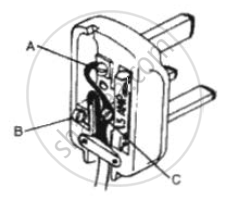
- Identify each of the colour coded wires by stating to which of the
terminals A, B or C in the diagram they should be connected. - Identify the terminal through which no current passes in normal
circumstances. - What is the purpose of the earthed wire connected to an electric
appliance like an electric heater? Describe how it works.
- What is meant by electric current?
- Name and define its unit.
- Which instrument is used to measure the electric current? How should it be connected in a circuit?
When an electric current is passed, electrons move from:
Match the following:
| 1. | 1 mA | a. | series |
| 2. | 1 pA | b. | ohmmeter |
| 3. | Ammeter | c. | 10-6 ampere |
| 4. | Electrical resistivity | d. | 10-3 ampere |
Electrons in a conductor move from:
The direction of Direct Current (DC) is characterized as:
In the process of current flow through a conductor, the amount of charge passing per unit time gives:
