Advertisements
Advertisements
Question
What is an Ammeter? How is It Connected in a Circuit? Draw a Diagram to Illustrate Your Answer.
Advertisements
Solution
An ammeter is an instrument that is used to measure electric current. It is always connected in series with the circuit in which the current is to be measured.

Suppose we want to find out the current flowing through a conductor AB. Here, we should connect the ammeter in series with the conductor AB as above.
APPEARS IN
RELATED QUESTIONS
Which of the following units could be used to measure electric charge?
(a) ampere
(b) joule
(c) volt
(d) coulomb
Why should the resistance of:
a voltmeter be very large?
One coulomb of charge flows through any cross-section of a conductor in 1 second. What is the current flowing through the conductor?
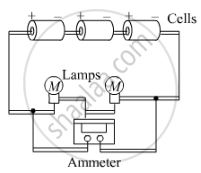
A student made an electric circuit shown here to measure the current through two lamps.
Are the lamps in series or parallel?
(a) Are the lamps in series or parallel?
(b) The student has made a mistake in this circuit. What is the mistake?
(c) Draw a circuit diagram to show the correct way to connect the circuit. Use the proper circuit symbols in your diagram.
A 5 V battery is connected to two 20 Ω resistors which are joined together in series.
(a) Draw a circuit diagram to represent this. Add an arrow to indicate the direction of conventional current flow in the circuit.
(b) What is the effective resistance of the two resistors?
(c) Calculate the current that flows from the battery?
(d) What is the p.d. across each resistor?
If the current passing through a conductor is doubled, what will be the change in heat produced
The following table shows the current in Amperes and potential differences in Volts.
- Find the average resistance.
- What will be the nature of the graph between the current and potential difference? (Do not draw a graph.)
- Which law will the graph prove? Explain the law.
| V (volts) | I (amp) |
| 4 | 9 |
| 5 | 11.25 |
| 6 | 13.5 |
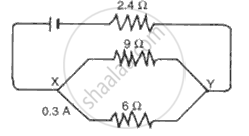
A current of 0.3 A is flowing through a branch of 6 Ω resistors in a junction as shown in fig. . Calculate the
(a) P.d. across the junction XY,
(b) Current flowing through 9Ω and 24Ω
( c) P.d. across 24 Ω resistor, and
( d) e.m.f. of the cell.
An electric kettle has a heating element which is rated at 2 kW when connected to a 250 V electric supply. Calculate the
(a) Current which flows in the element when it is connected to a 250 V supply,
(b) Resistance of the filament,
(c) Heat produced in 1 minute by the element,
(d) Cost of running the kettle for 10 minutes a day for 30 days of the month, at the rate of Rs. 3.00 per unit.
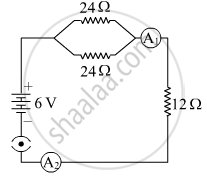
Study the following circuit and find out:
(i) Current in 12 Ω resistor.
(ii) The difference in the readings of A1 and A2, if any.
Small amounts of electrical current are measured in milliampere (mA). How many milliampere are there in 0.25 A ?
State whether true or false. If false, correct the statement.
Current can produce magnetic field.
Match the following:
| 1. | 1 mA | a. | series |
| 2. | 1 pA | b. | ohmmeter |
| 3. | Ammeter | c. | 10-6 ampere |
| 4. | Electrical resistivity | d. | 10-3 ampere |
Which of the following correctly represents the formula for electric current?
In metallic conductors, the charge carriers responsible for producing electric current are:
By convention, the direction of electric current in the external circuit is taken as:
Conventional current is defined as the direction in which which type of charge would flow?
In electrolytes such as salt solutions, the charge carriers are:
