Advertisements
Advertisements
प्रश्न
What is an Ammeter? How is It Connected in a Circuit? Draw a Diagram to Illustrate Your Answer.
Advertisements
उत्तर
An ammeter is an instrument that is used to measure electric current. It is always connected in series with the circuit in which the current is to be measured.

Suppose we want to find out the current flowing through a conductor AB. Here, we should connect the ammeter in series with the conductor AB as above.
APPEARS IN
संबंधित प्रश्न
By what name is the physical quantity coulomb/second called?
How many microamperes are there in 1 ampere?
A battery of 9 V is connected in series with resistors of 0.2 Ω, 0.3 Ω, 0.4 Ω, 0.5 Ω and 12 Ω. How much current would flow through the 12 Ω resistor?
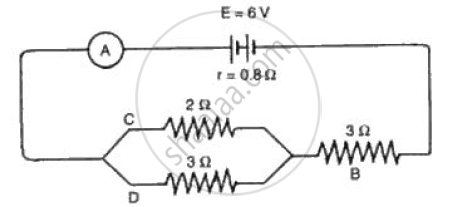
The circuit diagram (Fig.) shows a battery of e.m.f. 6 volts and internal
resistance of 0.8 Ω oonnected in series. Find the
(a) Current reoorded by the ammeter,
(b) P.d. across the terminals of the resistor B,
( c) Current passing through each of the resistors B, C and D, and
( d) P.d. across the terminals of the battery.
An electric oven is rated as 1.5 kW, 250 V. If it is connected to a 250 V mains, calculate the
(a) Current drawn,
(b) Energy consumed in 20 hours,
(c) Cost of energy consumed in 20 hours at the rate of Re. 1 per unit.
An auto lamp is joined to a battery of e.m.f. 4 V and internal resistance 2.5Ω. A steady current of 0.5 A flows through the circuit. Calculate the
(a) Total energy provided by battery in 10 minutes,
(b) Heat dissipated in the bulb in 10 minutes.
Explain with the help of a diagram how does 'short circuiting' occur in an electric kettle.
Tick (✓) the correct choice among the following :
Which of the following changes would enable a millimeter to be used as a
direct current ammeter reading upto 1 A?
Electrical power P is given by the expression P = (Q × V) ÷ time
(a) What do the symbols Q and V represent?
(b) Express the power P in terms of current and resistance explaining the meanings of symbols used there in.
A bulb is connected to a battery of p.d. 4 V and internal resistance 2.5 Ω . A steady current of 0.5 A flows through the circuit. Calculate:
The energy dissipated in the bulb in 10 minutes.
State the condition when it is advantageous to connect cells in parallel.
Three resistances, of which two are equal when connected in series have an effective resistance of 30 ohms. When the three resistances are connected in parallel, the effective resistances is 3 ohms. Find the values of the individual resistances.
True or False – If False give the correct answer
The representation of the electric current is A
What are the effects of electric current?
Electric current passes through a metallic conductor due to the movement of ______.
1020 electrons, each having a charge of 1.6 x 10⁻¹⁹ C, flows in a circuit V is 0.1s. What is the current in ampere?
The relationship between conventional current and electron flow is that they are:
