Advertisements
Advertisements
प्रश्न
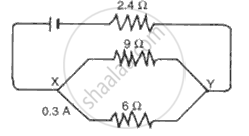
A current of 0.3 A is flowing through a branch of 6 Ω resistors in a junction as shown in fig. . Calculate the
(a) P.d. across the junction XY,
(b) Current flowing through 9Ω and 24Ω
( c) P.d. across 24 Ω resistor, and
( d) e.m.f. of the cell.
Advertisements
उत्तर
(a) Potential difference across XY = pot. cliff. across 6 Ω resistor
= 0.3 x 6=1.8V
b) Pot. difference across 9Ω resistor= pot. cliff. across 6 Ω resistor= 1.8 V
:. Current through 9Ω resistor = `1.8/9` = 0.2A
Current through 2.4Ω resistor = total current in the circuit = 0.3 + 0.2 = 0.5A
(c) p.d. across 2.4Ω resistor = 0.5 x 2.4 = 1.2 V
(d) emf of cell = p.d across 2.4Ω resistor+ pot cliff. across XY = 1.2 + 1.8 = 3.0 V
APPEARS IN
संबंधित प्रश्न
Fill in the folloing blank with suitable words:
A current is a flow of ............... .For this to happen there must be a ............... circuit.
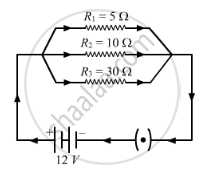
In the circuit diagram given below, three resistors R1, R2, and R3 of 5 Ω, 10 Ω and 30 Ω, respectively are connected as shown
Calculate:
- current through each resistor.
- total current in the circuit.
- total resistance in the circuit.
Ten bulbs are connected in a series circuit to a power supply line. Ten identical bulbs are connected in a parallel circuit to an identical power supply line.
(d) Which circuit would have less current in it?
Which is the better way to connect lights and other electrical appliances in domestic wiring: series circuits or parallel circuits? why?
Which effect of current is utilised in the working of an electric fuse?
Find the potential difference required to pass a current of 0.2 A in a wire of resistance 20Ω
A 720 W heater operates from a 220 V line voltage. Calculate:
(a) The electrical energy consumed by the heater in 3 h.
(b) The cost of electrical energy consumption at the rate of 60 paise per kWh.
An electrical appliance is rated at 1000 KVA, 220V. If the appliance is operated for 2 hours, calculate the energy consumed by the appliance in: (i) kWh (ii) joule.
