Advertisements
Advertisements
प्रश्न
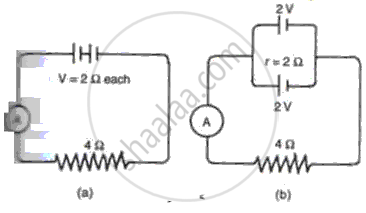
Two cells each having an e.m.f. of 2 V and an internal resistance of 2Ω are
connected (a) In series, and ( b) In para 1le l as shown in fig. . What is the
current flowing through the cir cu it in each_ case?
Advertisements
उत्तर
(a) Given, emf (e) of the battery= 2 x 2 = 4V,
internal resistance r = 2 x 2= 4Ω
Resistance in the circuit, R = 4 Ω
Total resistance of the given series circuit = 4 + 4 = 8Ω
Current flowing through the circuit, I = `"e"/("R" + "r") = 4/8 =0.5 "A"`
(b) Given, emf of battery ( e) = emf of each cell in parallel = 2V,
Total internal resistance `1/"r" = 1/2 + 1/2 = 1Ω`
Resistance connected in the circuit ,R = 4Ω
Total resistance of the circuit= 1 + 4 = 5 Ω
Current flowing through the circuit, I= `"e"/("R" + "r") = 2/5 = 0.4 "A"`
APPEARS IN
संबंधित प्रश्न
Why should the resistance of:
an ammeter be very small?
In 10 s, a charge of 25 C leaves a battery, and 200 J of energy are delivered to an outside circuit as a result.
- What is the p.d. across the battery?
- What current flows from the battery?
A 720 W heater operates from a 220 V line voltage. Calculate:
(a) The electrical energy consumed by the heater in 3 h.
(b) The cost of electrical energy consumption at the rate of 60 paise per kWh.
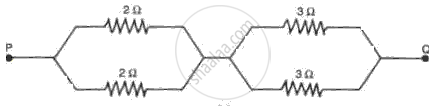
Find the effective resistance in the following circuit diagrams (Fig.):
60 joules of heat was dissipated in a resistor when 20 C flowed for 5 s. Calculate:
(a) P.d. across the resistor,
(b) Resistance of the resistor, and
(c) Average power dissipated in the resistor.
1 kWh = `(1 "volt" xx 1 "ampere" xx "_________")/1000`
How is direction of current related to the direction of flow of electrons?
How should the electric lamps in a building be connected?
The power of an electric device is a product of ______ and ______.
What is the rate at which charges flow past a point on a circuit?
