Advertisements
Advertisements
प्रश्न
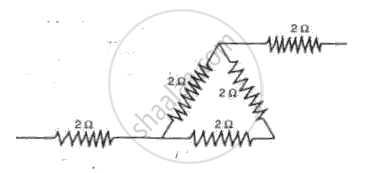
Find the effective resistance in the following circuit diagrams (Fig.):
Advertisements
उत्तर
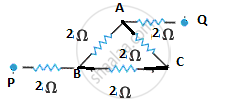
In the path ACB, the series combination of two 2Ω resistor is connected in parallel with the third 2Ω resistor.
:. resislancein series= 2 + 2 = 4 Ω
This 4 Ω resistor is now connected in parallel with the 2Ω resistor
total resistance between A and B `(1/"R"_"P") = 1/4 + 1/2 = 3/4 Ω`
`"R"_"P" = 4/3 Omega`
Now, between P and Q, two 2Ω resistors and `4/3` Ω are connected in series.
total resistance of the given network, R, = `2 + 2 + 4/3 = (6 + 6 + 4)/3 = 16/3 = 5.3Ω`
APPEARS IN
संबंधित प्रश्न
Draw the electrical symbols of the following components and state its use
Wire crossing
Three 2 V cells are connected in series and used as a battery in a circuit.
- What is the p.d. at the terminals of the battery?
- How many joules of electrical energy does 1 C gain on passing through
- one cell
- all three cells?
What is an Ammeter? How is It Connected in a Circuit? Draw a Diagram to Illustrate Your Answer.
An electric bulb of resistance 20 Ω and a resistance wire of 4 Ω are connected in series with a 6 V battery.
Draw the circuit diagram, and calculate:
(a) total resistance of the circuit.
(b) current through the circuit.
(c) potential difference across the electric bulb.
(d) potential difference across the resistance wire.
Draw a circuit diagram to show how two 4 V electric lamps can be lit brightly from two 2 V cells.
Ten bulbs are connected in a series circuit to a power supply line. Ten identical bulbs are connected in a parallel circuit to an identical power supply line.
(b) In which circuit, if one bulbs be brighter?
Which effect of current is utilised in an electric light bulb?
Find the potential difference required to pass a current of 0.2 A in a wire of resistance 20Ω
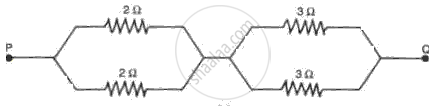
Find the effective resistance in the following circuit diagrams (Fig.):
Which of the following correctly represents the formula for electric current?
