Advertisements
Advertisements
प्रश्न
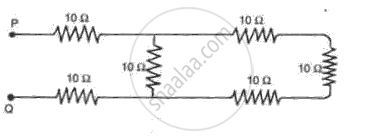
Find the effective resistance in the following circuit diagrams (Fig.):
Advertisements
उत्तर
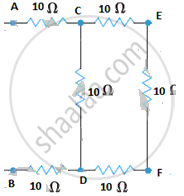
The situation consists of three 10 ohm resistors connected in series between CEFD and their combination in parallel with the fourth 10 ohm resistor between C and D.
Therefore, series combination gives, 10 + 10 + 10 = 30Ω .
This 30Ω resistor is connected in paral le I to the fourth 10 O resistor, therefore equivalent resistance between C and D,
Therefore, series combination gives, 10 + 10 + 10 = 30Ω
This 30Ω resistor is connected in paral le I to the fourth 10 Ω resistor, therefore equivalent resistance between C and D,
`1/"R" = 1/10 + 1/30 = 4/30 Ω`
R = 7.5Ω
Now, between A and B the resistance Rand two 10Ω resistors are connected in series.
Therefore, equivalent resistance between A and B is
`"R"_"total" = 10 + 10 + 7.5 = 27.5 Ω`
APPEARS IN
संबंधित प्रश्न
A current of 4 A flows around a circuit for 10 s. How much charge flows past a point in the circuit in this time?
Which type of circuit, series or parallel, is preferred while connecting a large number of bulbs:
(b) for lighting inside the rooms of the hotel?
What is international convention of colour coding in a cable?
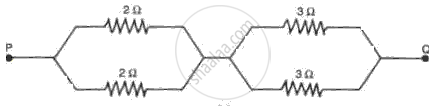
Find the effective resistance in the following circuit diagrams (Fig.):
A wire is passed through a piece of cardboard as shown in fig .. An electric current flows vertically down the wire and then flows back up. The two sections of the write are observed to repel each other.
(a) Wi th the aid of a diagram, describe how you would plot the magnetic field lines on the card .
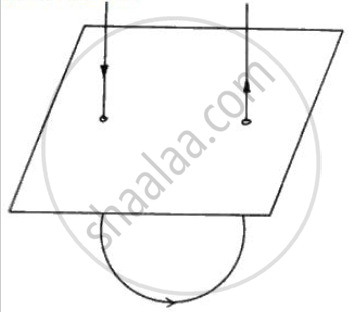
(b) Sketch the magnetic field patterns around both the sections of the wire. Use your sketch to explain why the two sections repel each other.
(c) The repulsive force between the two sections is small. What changes could be made to increase it?
Calculate the current through a 60 W lamp rated 250 V. If the line voltage falls to 200 V, how is power consumed by the bulb affected?
What should I choose ___________________
b. for getting protection from electric current.
c. to measure the current in the circuit?
State the condition when it is advantageous to connect cells in series.
Three resistances, of which two are equal when connected in series have an effective resistance of 30 ohms. When the three resistances are connected in parallel, the effective resistances is 3 ohms. Find the values of the individual resistances.
What does the direction of current convey?
