Advertisements
Advertisements
प्रश्न
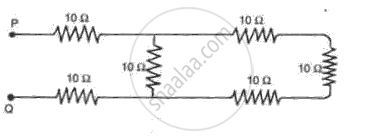
Find the effective resistance in the following circuit diagrams (Fig.):
Advertisements
उत्तर
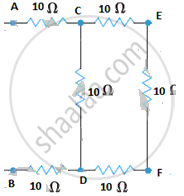
The situation consists of three 10 ohm resistors connected in series between CEFD and their combination in parallel with the fourth 10 ohm resistor between C and D.
Therefore, series combination gives, 10 + 10 + 10 = 30Ω .
This 30Ω resistor is connected in paral le I to the fourth 10 O resistor, therefore equivalent resistance between C and D,
Therefore, series combination gives, 10 + 10 + 10 = 30Ω
This 30Ω resistor is connected in paral le I to the fourth 10 Ω resistor, therefore equivalent resistance between C and D,
`1/"R" = 1/10 + 1/30 = 4/30 Ω`
R = 7.5Ω
Now, between A and B the resistance Rand two 10Ω resistors are connected in series.
Therefore, equivalent resistance between A and B is
`"R"_"total" = 10 + 10 + 7.5 = 27.5 Ω`
APPEARS IN
संबंधित प्रश्न
In which direction do electrons flow?
Which instrument is used to measure electric current? How should it be connected in a circuit?
Draw a circuit diagram showing two electric lamps connected in parallel together with a cell and a switch that works both lamps. Mark an â’¶ on your diagram to show where an ammeter should be placed to measure the current.
Two resistors of 2.0 Ω and 3.0 Ω are connected (a) in series (b) in parallel, with a battery of 6.0 V and negligible internal resistance. For each case draw a circuit diagram and calculate the current through the battery.
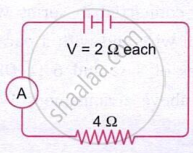
Two cells each having an e.m.f. of 2 V and an internal resistance of \(2,\Omega\) are connected in series as shown in Fig. What is the current flowing through the circuit in each case?
Tick (✓) the correct choice among the following :
There are 500 turns and 2000 turns in the primary and secondary coil of a
transformer respectively. If th e output voltage is 1000 V, how large is the
input voltage?
A bulb is connected to a battery of p.d. 4 V and internal resistance 2.5 Ω . A steady current of 0.5 A flows through the circuit. Calculate:
The energy dissipated in the bulb in 10 minutes.
An electric bulb is marked 100 W, 250 V. How much current will the bulb draw if connected to a 250 V supply?
In the process of current flow through a conductor, the amount of charge passing per unit time gives:
