Advertisements
Advertisements
Question
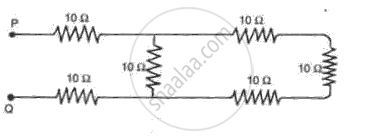
Find the effective resistance in the following circuit diagrams (Fig.):
Advertisements
Solution
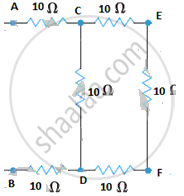
The situation consists of three 10 ohm resistors connected in series between CEFD and their combination in parallel with the fourth 10 ohm resistor between C and D.
Therefore, series combination gives, 10 + 10 + 10 = 30Ω .
This 30Ω resistor is connected in paral le I to the fourth 10 O resistor, therefore equivalent resistance between C and D,
Therefore, series combination gives, 10 + 10 + 10 = 30Ω
This 30Ω resistor is connected in paral le I to the fourth 10 Ω resistor, therefore equivalent resistance between C and D,
`1/"R" = 1/10 + 1/30 = 4/30 Ω`
R = 7.5Ω
Now, between A and B the resistance Rand two 10Ω resistors are connected in series.
Therefore, equivalent resistance between A and B is
`"R"_"total" = 10 + 10 + 7.5 = 27.5 Ω`
APPEARS IN
RELATED QUESTIONS
What actually travels through the wires when you switch on a light?
How many microamperes are there in 1 ampere?
Ten bulbs are connected in a series circuit to a power supply line. Ten identical bulbs are connected in a parallel circuit to an identical power supply line.
(b) In which circuit, if one bulbs be brighter?
A battery of e.m.f. 15 V and internal resistance 3 ohm is connected to two resistors of resistance 3 ohm and 6 ohm in series. Find:
(i) The current through the battery,
(ii) The p.d. between the terminals of the battery.
Calculate the current through a 60 W lamp rated 250 V. If the line voltage falls to 200 V, how is power consumed by the bulb affected?
Small amounts of electrical current are measured in milliampere (mA). How many milliampere are there in 0.25 A ?
In metallic conductors, the charge carriers responsible for producing electric current are:
In ionised gases (plasma), the charge carriers are:
