Advertisements
Advertisements
Question
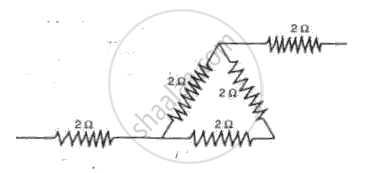
Find the effective resistance in the following circuit diagrams (Fig.):
Advertisements
Solution
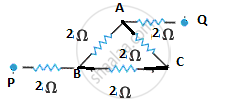
In the path ACB, the series combination of two 2Ω resistor is connected in parallel with the third 2Ω resistor.
:. resislancein series= 2 + 2 = 4 Ω
This 4 Ω resistor is now connected in parallel with the 2Ω resistor
total resistance between A and B `(1/"R"_"P") = 1/4 + 1/2 = 3/4 Ω`
`"R"_"P" = 4/3 Omega`
Now, between P and Q, two 2Ω resistors and `4/3` Ω are connected in series.
total resistance of the given network, R, = `2 + 2 + 4/3 = (6 + 6 + 4)/3 = 16/3 = 5.3Ω`
APPEARS IN
RELATED QUESTIONS
How many microamperes are there in 1 ampere?
Ten bulbs are connected in a series circuit to a power supply line. Ten identical bulbs are connected in a parallel circuit to an identical power supply line.
- Which circuit would have the highest voltage across each bulb?
- In which circuit would the bulbs be brighter?
- In which circuit, if one bulb blows out, all others will stop glowing?
- Which circuit would have less current in it?
An electric current flowing in a wire creates ______ around the wire.
Tick(✓) the correct choice in the following:
A three pin plug is connected to the lead for a 1 kW electric iron to be
used on a 250 V supply. Which of the following statements is not correct?
True or False – If False give the correct answer
The representation of the electric current is A
Define an electric current.
The relationship between conventional current and electron flow is that they are:
