Advertisements
Advertisements
Question
Advertisements
Solution
We know that, P =VI
I = `"P"/"V" = 40/220` = 0.11 A
APPEARS IN
RELATED QUESTIONS
A battery and three lamps are connected as shown:
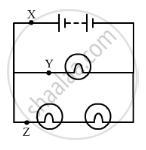
Which of the following statements about the currents at X, Y and Z is correct?
(a) The current at Z is greater than that at Y.
(b) The current at Y is greater than that at Z.
(c) The current at X equals the current at Y.
(d) The current at X equals the current at Z.
Define the term resistivity.
Two cells each having an e.m.f. of 2 V and an internal resistance of \(2,\Omega\) are connected in series as shown in Fig. What is the current flowing through the circuit in each case?
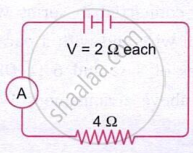
Tick (✓) the correct choice among the following :
There are 500 turns and 2000 turns in the primary and secondary coil of a
transformer respectively. If th e output voltage is 1000 V, how large is the
input voltage?
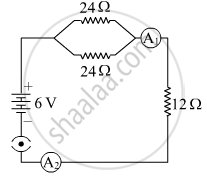
Study the following circuit and find out:
(i) Current in 12 Ω resistor.
(ii) The difference in the readings of A1 and A2, if any.
Match the items in column-I to the items in column-II:
| Column - I | Column - II | ||
| (i) | electric current | (a) | volt |
| (ii) | potential difference | (b) | ohm meter |
| (iii) | specific resistance | (c) | watt |
| (iv) | electrical power | (d) | joule |
| (v) | electrical energy | (e) | ampere |
The direction of Direct Current (DC) is characterized as:
Common sources of Direct Current (DC) are:
