Advertisements
Advertisements
Question
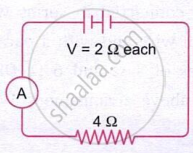
Two cells each having an e.m.f. of 2 V and an internal resistance of \(2,\Omega\) are connected in series as shown in Fig. What is the current flowing through the circuit in each case?
Advertisements
Solution
Given: EMF of each cell, \(E=2\,V\)
Internal resistance of each cell, \(r=2\,\Omega\)
External resistance, \(R=4\,\Omega\)
When cells are connected in parallel,
Equivalent EMF:
\[ E=2\,V \]
Equivalent internal resistance:
\[ r=\frac{2\times2}{2+2}\]
= 1 Ω
Current flowing:
\[ I=\frac{E}{R+r}\]
\[=\frac{2}{4+1} \]
\[ {=0.4\,A} \]
APPEARS IN
RELATED QUESTIONS
The p.d. across a 3 Ω resistor is 6 V. The current flowing in the resistor will be:
(a) `1/2A`
(b) 1 A
(c) 2 A
(d) 6 A
V1, V2 and V3 are the p.ds. across the 1Ω, 2Ω and 3Ω resistors in the following diagram, and the current is 5 A.
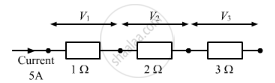
Which one of the columns (a) to (d) shows the correct values of V1, V2 and V3measured in volts?
`V_1` `V_2` `V_3`
(a) 1.0 2.0 3.0
(b) 5.0 10.0 15.0
(c) 5.0 2.5 1.6
(d) 4.0 4.0 2.0
You can given one hundred 1 Ω resistors. What is the smallest and largest resistance you can make in a circuit using these?
Tick(✓) the correct choice in the following:
When the length of a conductor is doubled the resistance of the conductor
will
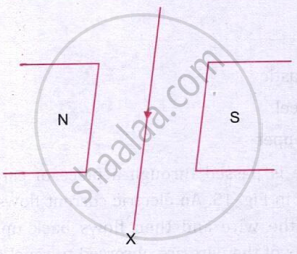
In fig. XY is at right angles to the magnetic field. The direction in which XY should be moved to induce an electron flow in the direction Y to X as indicated by the arrow is:
A bulb is connected to a battery of p.d. 4 V and internal resistance 2.5 Ω . A steady current of 0.5 A flows through the circuit. Calculate:
The resistance of the bulb
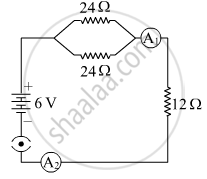
Study the following circuit and find out:
(i) Current in 12 Ω resistor.
(ii) The difference in the readings of A1 and A2, if any.
When an electric current is passed, electrons move from:
