Advertisements
Advertisements
Question
60 joules of heat was dissipated in a resistor when 20 C flowed for 5 s. Calculate:
(a) P.d. across the resistor,
(b) Resistance of the resistor, and
(c) Average power dissipated in the resistor.
Advertisements
Solution
Given, heat dissipated= 60 joules, charge Q = 20 C, time t= 5s
(a) P.d. across the rsistor, V = `"W"/"Q"= 60/20 = 3 "V"`
(b) Power = `"W"/"t" = "V"^2/"R"`
R = `"V"^2 xx "t"/"W" = (3)^2 xx 5/60 = 0.75 Omega`
(c) Power dissipated, P = `"W"/"t" = 60/5 = 12 "watt"`
APPEARS IN
RELATED QUESTIONS
Three 2 V cells are connected in series and used as a battery in a circuit.
- What is the p.d. at the terminals of the battery?
- How many joules of electrical energy does 1 C gain on passing through
- one cell
- all three cells?
By what name is the physical quantity coulomb/second called?
A flash of lighting carries 10 C of charge which flows for 0.01 s. What is the current? If the voltage is 10 MV, what is the energy?
What happens to the other bulbs in a parallel circuit if one bulb blows off?
Draw a circuit diagram showing two electric lamps connected in parallel together with a cell and a switch that works both lamps. Mark an â’¶ on your diagram to show where an ammeter should be placed to measure the current.
Consider the circuit given below when A, B and C are three identical light bulbs of constant resistance. 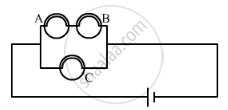
(a) List the bulbs in order of increasing brightness.
(b) If C burns out, what will be the brightness of A now compared with before?
(c) If B burns out instead, what will be the brightness of A and C compared with before?
When an electric current is passed, electrons move from:
In the process of current flow through a conductor, the amount of charge passing per unit time gives:
