Advertisements
Advertisements
Question
Ten bulbs are connected in a series circuit to a power supply line. Ten identical bulbs are connected in a parallel circuit to an identical power supply line.
(c) In which circuit, if one bulb blows out, all other will stop glowing?
Advertisements
Solution
(c) Series circuit
RELATED QUESTIONS
What does an electric circuit mean?
Draw the electrical symbols of the following components and state its use:
Rheostat (variable resistance)
Write down the formula which relates electric charge, time and electric current
State the factors on which the strength of electric current flowing in a given conductor depends.
Ten bulbs are connected in a series circuit to a power supply line. Ten identical bulbs are connected in a parallel circuit to an identical power supply line.
(b) In which circuit, if one bulbs be brighter?
An electric bulb is rated as 10 W, 220 V. How many of these bulbs can be connected in parallel across the two wires of 220 V supply line if the maximum current which can be drawn is 5 A?
Draw a schematic diagram of an electric circuit consisting of a battery of two cells each of 1.5 V, 5 Ω, 10 Ω and 15 Ω resistors and a plug key, all connected in series.
In the circuit shown in fig., find the reading of the ammeter A when the switch S is opened.
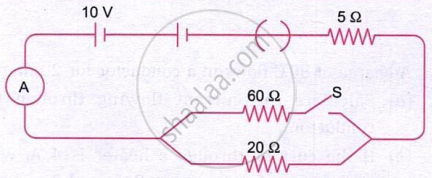
State the S.I. units of electrical power.
Complete the following:
1 kWh = _________ J
A current of 0.2 A flows through a wire whose ends are at a potential difference of 15 V. Calculate:
(i) The resistance of the wire, and
(ii) The heat energy produced in 1 minute.
Answer the following question.
What is the function of a galvanometer in a circuit?
Water : pipe :: Electric current : ______.
The power of an electric device is a product of ______ and ______.
Coulomb is the SI unit of ____________.
Electrons in a conductor move from:
