Advertisements
Advertisements
Question
Draw a schematic diagram of an electric circuit consisting of a battery of two cells each of 1.5 V, 5 Ω, 10 Ω and 15 Ω resistors and a plug key, all connected in series.
Advertisements
Solution
The emf of each cell is 1.5 V.
When the two cells are connected in series, the emf of the battery becomes (1.5 + 1.5) V = 3 V.
Therefore, the schematic diagram of the series circuit is as follows: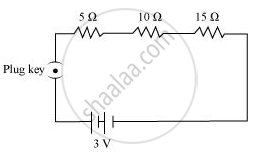
APPEARS IN
RELATED QUESTIONS
One coulomb charge is equivalent to the charge contained in:
(a) 2.6 × 10¹⁹ electrons
(b) 6.2 × 10¹⁹ electrons
(c) 2.65 × 10¹⁸ electrons
(d) 6.25 × 10¹⁸ electrons
How many microamperes are there in 1 ampere?
A flash of lighting carries 10 C of charge which flows for 0.01 s. What is the current? If the voltage is 10 MV, what is the energy?
Draw a circuit diagram showing two lamps, one cell and a switch connected in series.
How can you change the brightness of the lamp?
Tick(✓) the correct choice in the following:
When the length of a conductor is doubled the resistance of the conductor
will
A charge of 80 C flows in a conductor for 2 minutes.
(a) Calculate the current flowing through the conductor.
(b) If the current through a heater is 4 A what charge must be passing in 8 seconds?
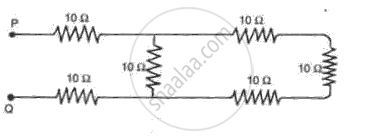
Find the effective resistance in the following circuit diagrams (Fig.):
An electrical appliance is rated at 1000 KVA, 220V. If the appliance is operated for 2 hours, calculate the energy consumed by the appliance in: (i) kWh (ii) joule.
When an electric current is passed, electrons move from:
The flow of electric charge per unit time is called potential difference.
