Advertisements
Advertisements
Question
Advertisements
Solution
An ammeter is a low resistance device; hence it is connected in series.
A voltmeter is a high resistance device; hence it is connected in parallel.
APPEARS IN
RELATED QUESTIONS
What is the Flow of Charge Called?
What is an electric current?
Name two effects produced by electric current.
A switch must be connected in ______.
Two resistors of 2.0 Ω and 3.0 Ω are connected (a) in series (b) in parallel, with a battery of 6.0 V and negligible internal resistance. For each case draw a circuit diagram and calculate the current through the battery.
If a charge of 420 C flows through a conducting wire in 5 minutes what is the value of the current?
What would be the danger involved in replacing a blown fuse with the one which would carry a large current?
Tick (✓) the correct choice among the following :
In fig .XY is at right angles to the magnetic field. The direction in
which XY should be moved to induce an electron flow in the direction Y to X as indicated by the arrow is
Fig . shows the core of a transformer and i ts input and output connections
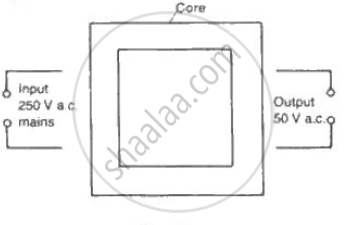
State the material used for the core and describe th e structure of the core.
(a) Use the values given in the diagram to calculate the turns ratio for the transformer and connections, labeling all parts of the diagram .
(b) If a current of 2 A is taken from th e output, calculate th e current in the input circuit (Assume the transformer to be ideal ).
Give the electric current unit.
