Advertisements
Advertisements
Question
Advertisements
Solution
Given, P = 100 W, p.d. = 220 V
We know that,
P = `"V"^2/"R"`
P = `"V"^2/"R" = *(220)^2/100 = 484 Omega`
Also, we know that,
P=VI
I = `"P"/"V" = 100/220 = 0.45`A
Thus a fuse of rating 7A may be used with the appliance and it should be connected in the live wire before connectimg it to the appliance
APPEARS IN
RELATED QUESTIONS
Fill in the blank:
To increase the effective resistance in a circuit the resistors are connected in _____________.
Why should the resistance of:
a voltmeter be very large?
State three factors on which the heat produced by an electric current depends. How does it depend on these factors?
An electric current flowing in a wire creates ______ around the wire.
Tick(✓) the correct choice in the following:
The outer casing of an electric iron is generally connected to earth in order
to
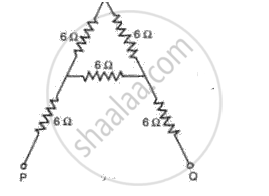
Find the effective resistance in the following circuit diagrams (Fig.):
What determines the direction of flow of electrons between two charged conductors kept in contact?
What is the SI unit for the current?
The direction of Direct Current (DC) is characterized as:
The RMS value of AC is defined as:
