Advertisements
Advertisements
Question
The following table shows the current in Amperes and potential differences in Volts.
- Find the average resistance.
- What will be the nature of the graph between the current and potential difference? (Do not draw a graph.)
- Which law will the graph prove? Explain the law.
| V (volts) | I (amp) |
| 4 | 9 |
| 5 | 11.25 |
| 6 | 13.5 |
Advertisements
Solution
From the following table,
V1 = 4V, V2 = 5V, V3 = 6V
I1 = 9 A, I2 = 11.25 A, I3 = 13.5 A
`R_1 = V_1/I_1 = 4/9` = 0.44 Ω
`R_2 = V_2/I_2 = 5/11.25` = 0.44 Ω
`R_3 = V_3/I_3 = 6/13.5` = 0.44 Ω
| V (Volt) | I (Ampere) | R(Ω) = `bb(V/I)` |
| 4 | 9 | 0.44 |
| 5 | 11.25 | 0.44 |
| 6 | 13.5 | 0.44 |
a. Average resistance (R) = `(R_1 + R_2 + R_3)/3`
= `(0.44 + 0.44 + 0.44)/3`
= `1.32/3 = 0.44`
∴ Average resistance (R) = 0.44 Ω
b. A straight line will pass through the origin (0, 0) on the graph between current and potential difference.
c. Here `V_1/I_1 = V_2/I_2 = V_3/I_3` i.e. Ohm’s law is clear from I ∝ V.
APPEARS IN
RELATED QUESTIONS
What is the Flow of Charge Called?
Which of the following equation shows the correct relationship between electrical unit?
1A = 1C/s or 1c= 1A/s
What is an Ammeter? How is It Connected in a Circuit? Draw a Diagram to Illustrate Your Answer.
One coulomb of charge flows through any cross-section of a conductor in 1 second. What is the current flowing through the conductor?
How many electrons are flowing per second past a point in a circuit in which there is a current of 5 amp?
The diagram shows two ways of connecting three lamps P, Q and R to A.C. supply of 220 V.
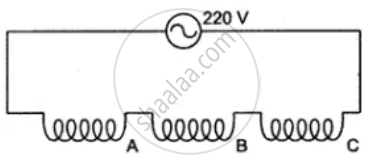
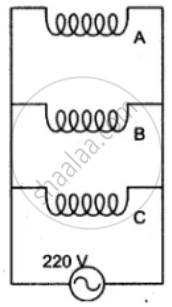
Tick(✓) the correct choice in the following:
A three pin plug is connected to the lead for a 1 kW electric iron to be
used on a 250 V supply. Which of the following statements is not correct?
Find the effective resistance in the following circuit diagrams (Fig.):
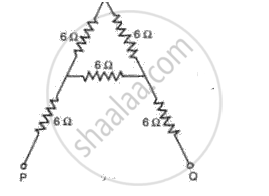
Electrical power P is given by the expression P = (Q × V) ÷ time
(a) What do the symbols Q and V represent?
(b) Express the power P in terms of current and resistance explaining the meanings of symbols used there in.
State the condition when it is advantageous to connect cells in parallel.
Which part of an electrical appliance is earthed?
State the conditions for the flow of charge in a circuit from one point to the other.
MCB is used to protect household electrical appliances.
Conventionally, the direction of the current is taken as:
Electric current passes through a metallic conductor due to the movement of ______.
By convention, the direction of electric current in the external circuit is taken as:
Conventional current is defined as the direction in which which type of charge would flow?
Which of the following is the example expression for Alternating Current?
