Advertisements
Advertisements
प्रश्न
The following table shows the current in Amperes and potential differences in Volts.
- Find the average resistance.
- What will be the nature of the graph between the current and potential difference? (Do not draw a graph.)
- Which law will the graph prove? Explain the law.
| V (volts) | I (amp) |
| 4 | 9 |
| 5 | 11.25 |
| 6 | 13.5 |
Advertisements
उत्तर
From the following table,
V1 = 4V, V2 = 5V, V3 = 6V
I1 = 9 A, I2 = 11.25 A, I3 = 13.5 A
`R_1 = V_1/I_1 = 4/9` = 0.44 Ω
`R_2 = V_2/I_2 = 5/11.25` = 0.44 Ω
`R_3 = V_3/I_3 = 6/13.5` = 0.44 Ω
| V (Volt) | I (Ampere) | R(Ω) = `bb(V/I)` |
| 4 | 9 | 0.44 |
| 5 | 11.25 | 0.44 |
| 6 | 13.5 | 0.44 |
a. Average resistance (R) = `(R_1 + R_2 + R_3)/3`
= `(0.44 + 0.44 + 0.44)/3`
= `1.32/3 = 0.44`
∴ Average resistance (R) = 0.44 Ω
b. A straight line will pass through the origin (0, 0) on the graph between current and potential difference.
c. Here `V_1/I_1 = V_2/I_2 = V_3/I_3` i.e. Ohm’s law is clear from I ∝ V.
APPEARS IN
संबंधित प्रश्न
Choose the correct alternative and rewrite the following sentence.
When the resistance of a conductor increases, the current will ________ increase.
The atoms of copper contain electrons and the atoms of rubber also contain electrons. Then why does copper conduct electricity but rubber does not conduct electricity?
How many milliamperes as there in 1 ampere?
A Radio Set Draws a Current of 0.36 a for 15 Minutes. Calculate the Amount of Electric Charge that Flows Through the Circuit.
In the circuit shown below, the voltmeter reads 10 V.
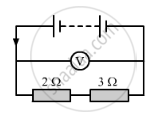
(a) What is the combined resistance?
(b) What current flows?
(c) What is the p.d. across 2 Ω resistor?
(d) What is the p.d. across 3 Ω resistor?
Draw a circuit diagram to show how two 4 V electric lamps can be lit brightly from two 2 V cells.
Ten bulbs are connected in a series circuit to a power supply line. Ten identical bulbs are connected in a parallel circuit to an identical power supply line.
(c) In which circuit, if one bulb blows out, all other will stop glowing?
If you were going to connect two light bulbs to one battery, would you use a series or a parallel arrangement? Why? Which arrangement takes more current from the battery?
An electrician has wired a house in such a way that if a lamp gets fused in one room of the house, all the lamps in other rooms of the house stop working. What is the defect in the wiring?
If the current passing through a conductor is doubled, what will be the change in heat produced
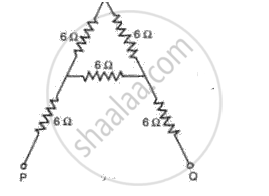
Find the effective resistance in the following circuit diagrams (Fig.):
Electrical power P is given by the expression P = (Q × V) ÷ time
(a) What do the symbols Q and V represent?
(b) Express the power P in terms of current and resistance explaining the meanings of symbols used there in.
How is direction of current related to the direction of flow of electrons?
Three resistances, of which two are equal when connected in series have an effective resistance of 30 ohms. When the three resistances are connected in parallel, the effective resistances is 3 ohms. Find the values of the individual resistances.
- What is meant by electric current?
- Name and define its unit.
- Which instrument is used to measure the electric current? How should it be connected in a circuit?
The SI unit of electric current is:
By convention, the direction of electric current in the external circuit is taken as:
The relationship between conventional current and electron flow is that they are:
The value used for practical measurement of Alternating Current is the:
