Advertisements
Advertisements
प्रश्न
The following table shows the current in Amperes and potential differences in Volts.
- Find the average resistance.
- What will be the nature of the graph between the current and potential difference? (Do not draw a graph.)
- Which law will the graph prove? Explain the law.
| V (volts) | I (amp) |
| 4 | 9 |
| 5 | 11.25 |
| 6 | 13.5 |
Advertisements
उत्तर
From the following table,
V1 = 4V, V2 = 5V, V3 = 6V
I1 = 9 A, I2 = 11.25 A, I3 = 13.5 A
`R_1 = V_1/I_1 = 4/9` = 0.44 Ω
`R_2 = V_2/I_2 = 5/11.25` = 0.44 Ω
`R_3 = V_3/I_3 = 6/13.5` = 0.44 Ω
| V (Volt) | I (Ampere) | R(Ω) = `bb(V/I)` |
| 4 | 9 | 0.44 |
| 5 | 11.25 | 0.44 |
| 6 | 13.5 | 0.44 |
a. Average resistance (R) = `(R_1 + R_2 + R_3)/3`
= `(0.44 + 0.44 + 0.44)/3`
= `1.32/3 = 0.44`
∴ Average resistance (R) = 0.44 Ω
b. A straight line will pass through the origin (0, 0) on the graph between current and potential difference.
c. Here `V_1/I_1 = V_2/I_2 = V_3/I_3` i.e. Ohm’s law is clear from I ∝ V.
APPEARS IN
संबंधित प्रश्न
A flash of lighting carries 10 C of charge which flows for 0.01 s. What is the current? If the voltage is 10 MV, what is the energy?
V1, V2 and V3 are the p.ds. across the 1Ω, 2Ω and 3Ω resistors in the following diagram, and the current is 5 A.
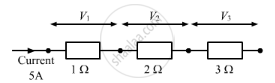
Which one of the columns (a) to (d) shows the correct values of V1, V2 and V3measured in volts?
`V_1` `V_2` `V_3`
(a) 1.0 2.0 3.0
(b) 5.0 10.0 15.0
(c) 5.0 2.5 1.6
(d) 4.0 4.0 2.0
The lamps in a house hold circuit are connected in parallel because:
(a) this way they required less current
(b) if one lamp fails the others remain lit
(c) this way they require less power
(d) if one lamp fails the other also fail
Draw a circuit diagram showing two lamps, one cell and a switch connected in series.
How can you change the brightness of the lamp?
State three factors on which the heat produced by an electric current depends. How does it depend on these factors?
Two resistors of 2.0 Ω and 3.0 Ω are connected (a) in series (b) in parallel, with a battery of 6.0 V and negligible internal resistance. For each case draw a circuit diagram and calculate the current through the battery.
A cell supplies a current of 1.2 A through two 2 Ω resistors connected in parallel. When the resistors are connected in series, it supplies a current of 0.4 A. Calculate:
(i) the internal resistance and (ii) e.m.f. of the cell.
A 720 W heater operates from a 220 V line voltage. Calculate:
(a) The electrical energy consumed by the heater in 3 h.
(b) The cost of electrical energy consumption at the rate of 60 paise per kWh.
A fuse is a short piece of wire of high ______ and low ______.
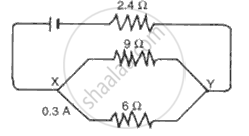
A current of 0.3 A is flowing through a branch of 6 Ω resistors in a junction as shown in fig. . Calculate the
(a) P.d. across the junction XY,
(b) Current flowing through 9Ω and 24Ω
( c) P.d. across 24 Ω resistor, and
( d) e.m.f. of the cell.
What would be the danger involved in replacing a blown fuse with the one which would carry a large current?
In fig. XY is at right angles to the magnetic field. The direction in which XY should be moved to induce an electron flow in the direction Y to X as indicated by the arrow is:
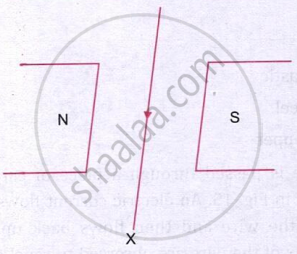
Tick (✓) the correct choice among the following :
There are 500 turns and 2000 turns in the primary and secondary coil of a
transformer respectively. If th e output voltage is 1000 V, how large is the
input voltage?
An electric iron is rated 750 W, 230 V. Calculate the electrical energy consumed by the press in 16 hours.
Answer the following question.
An electric lamp of resistance 20 Ω and a conductor of resistance 4 0 are connected to a 6 V battery as shown in the circuit. Calculate: 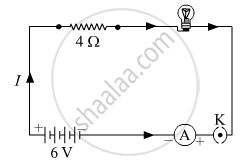
(a) the total resistance of the circuit,
(b) the current through the circuit,
(c) the potential difference across the (i) electric lamp and (ii) conductor, and
(d) power of the lamp.
What is the SI unit for the current?
In metallic conductors, the charge carriers responsible for producing electric current are:
A charge of 20 C flows through a conductor in 4 s. The electric current through the conductor is:
In the process of current flow through a conductor, the amount of charge passing per unit time gives:
