Advertisements
Advertisements
प्रश्न
A current of 0.2 A flows through a wire whose ends are at a potential difference of 15 V. Calculate:
(i) The resistance of the wire, and
(ii) The heat energy produced in 1 minute.
Advertisements
उत्तर
Given ,
Current, I = 0.2 A
Potential difference , V = 15 V
Time ,t = 60 sec
As V = IR
(a) R = `15/0.2 = 75 Omega`
(b) Heat energy , H = I2Rt
H = (0.2)2 × 75 × 60
or H = 180 J
संबंधित प्रश्न
How many milliamperes as there in 1 ampere?
In the circuit diagram given below, three resistors R1, R2, and R3 of 5 Ω, 10 Ω and 30 Ω, respectively are connected as shown
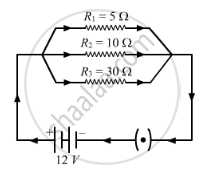
Calculate:
- current through each resistor.
- total current in the circuit.
- total resistance in the circuit.
Tick(✓) the correct choice in the following:
Which of the following quantities has the same value for all electrical
appliances connected to the ring main circuit in a house?
What is the function of a step-up transformer?
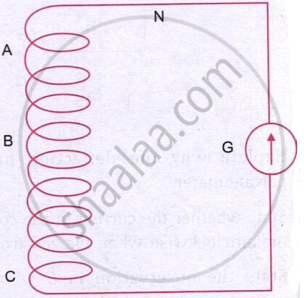
A strong short bar magnet is dropped into a solenoid connected to a
galvanometer as shown in fig. The galvanometer shows a deflection to the left when the current in the coil as seen from above is counter clockwise. Which one of the following shows the correct deflection of the galvanometer when the magnet is at posi tions A, Band C.
How is direction of current related to the direction of flow of electrons?
Conventionally, the direction of the current is taken as:
