Advertisements
Advertisements
प्रश्न
Two resistors of 2.0 Ω and 3.0 Ω are connected (a) in series (b) in parallel, with a battery of 6.0 V and negligible internal resistance. For each case draw a circuit diagram and calculate the current through the battery.
Advertisements
उत्तर
(a) In Series -
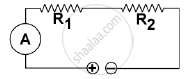
R1 = 2 Ω
R2 = 3 Ω
R = R1 + R2 = 2 + 3 = 5 Ω
V = 6 V
`"I" = "V"/"R"`
I `= 6/5`
I = 1.2 A
(b) In Parallel -
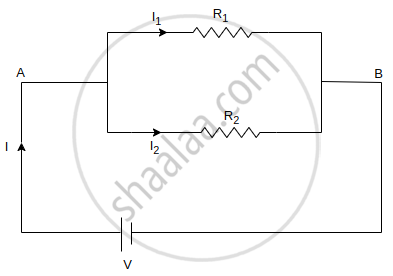
R1 and R2 are connected in parallel
`1/"R" = 1/"R"_1 + 1/"R"_2`
`1/"R" = 1/2+1/3`
`1/"R" = 5/6`
R = `6/5` = 1.2 Ω
V = 6V
I `= "V"/"R"`
`= 6/1.2`
= 5 A
संबंधित प्रश्न
Compare how an ammeter and a voltmeter are connected in a circuit.
A flash of lighting carries 10 C of charge which flows for 0.01 s. What is the current? If the voltage is 10 MV, what is the energy?
You can given one hundred 1 Ω resistors. What is the smallest and largest resistance you can make in a circuit using these?
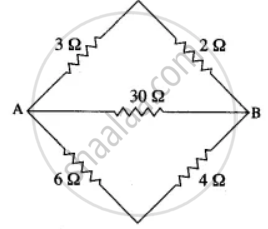
Calculate the equivalent resistance between A and B in the adjacent diagram.
Tick(✓) the correct choice in the following:
The outer casing of an electric iron is generally connected to earth in order
to
Electrical appliances have voltage and power ratings as listed below. Which
has the larger working resistance?
| Appliances | Voltage (V) | Power (W) |
| (a) Washing machine | 250 | 3000 |
| ( b) Television | 240 | 160 |
| (c)240 | 240 | 1500 |
| ( d) Hair curler | 250 | 20 |
| ( e) Car head lamp | 12 | 36 |
State the condition when it is advantageous to connect cells in series.
The electron was discovered in 1897 by:
In semiconductors, the charge carriers are:
