Advertisements
Advertisements
प्रश्न
Two resistors of 2.0 Ω and 3.0 Ω are connected (a) in series (b) in parallel, with a battery of 6.0 V and negligible internal resistance. For each case draw a circuit diagram and calculate the current through the battery.
Advertisements
उत्तर
(a) In Series -
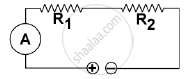
R1 = 2 Ω
R2 = 3 Ω
R = R1 + R2 = 2 + 3 = 5 Ω
V = 6 V
`"I" = "V"/"R"`
I `= 6/5`
I = 1.2 A
(b) In Parallel -
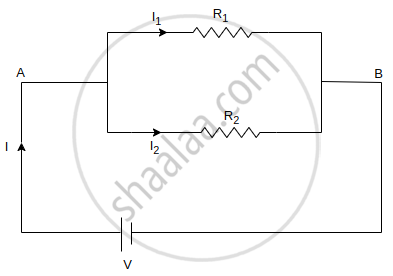
R1 and R2 are connected in parallel
`1/"R" = 1/"R"_1 + 1/"R"_2`
`1/"R" = 1/2+1/3`
`1/"R" = 5/6`
R = `6/5` = 1.2 Ω
V = 6V
I `= "V"/"R"`
`= 6/1.2`
= 5 A
संबंधित प्रश्न
Which particles constitute the electric current in a metallic conductor?
A battery of 9 V is connected in series with resistors of 0.2 Ω, 0.3 Ω, 0.4 Ω, 0.5 Ω and 12 Ω. How much current would flow through the 12 Ω resistor?
Draw a circuit diagram to show how two 4 V electric lamps can be lit brightly from two 2 V cells.
An electric bulb is rated as 10 W, 220 V. How many of these bulbs can be connected in parallel across the two wires of 220 V supply line if the maximum current which can be drawn is 5 A?
Electrical appliances have voltage and power ratings as listed below. Which
has the larger working resistance?
| Appliances | Voltage (V) | Power (W) |
| (a) Washing machine | 250 | 3000 |
| ( b) Television | 240 | 160 |
| (c)240 | 240 | 1500 |
| ( d) Hair curler | 250 | 20 |
| ( e) Car head lamp | 12 | 36 |
What does the direction of current convey?
