Advertisements
Advertisements
Question
Two resistors of 2.0 Ω and 3.0 Ω are connected (a) in series (b) in parallel, with a battery of 6.0 V and negligible internal resistance. For each case draw a circuit diagram and calculate the current through the battery.
Advertisements
Solution
(a) In Series -
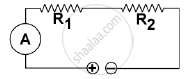
R1 = 2 Ω
R2 = 3 Ω
R = R1 + R2 = 2 + 3 = 5 Ω
V = 6 V
`"I" = "V"/"R"`
I `= 6/5`
I = 1.2 A
(b) In Parallel -
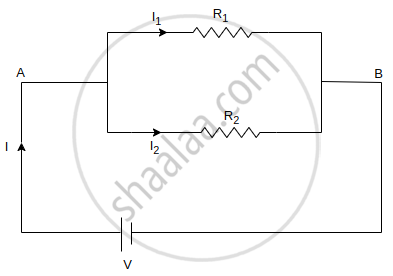
R1 and R2 are connected in parallel
`1/"R" = 1/"R"_1 + 1/"R"_2`
`1/"R" = 1/2+1/3`
`1/"R" = 5/6`
R = `6/5` = 1.2 Ω
V = 6V
I `= "V"/"R"`
`= 6/1.2`
= 5 A
RELATED QUESTIONS
Which of the two is connected in series : ammeter or voltmeter?
In 10 s, charge of 25 C leaves a battery, and 200 J of energy are delivered to an outside circuit a result.
What current flows from the battery?
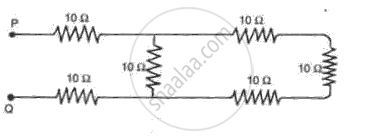
Find the effective resistance in the following circuit diagrams (Fig.):
A 3 pin mains plug is fitted to the lead for a 1 kW electric kettle to be used on a 250 V A.C. supply. Which of the following statements is NOT correct?
(a) A 13 A fuse is the most appropriate value to use.
(b) The brown wire should be connected to the live side of the mains.
An electric bulb is rated at 220 V, 100 W.
- What is its resistance?
- What safe current can be passed through it?
State the condition when it is advantageous to connect cells in series.
Which of the following correctly represents the formula for electric current?
