Advertisements
Advertisements
Question
Consider the circuit given below:
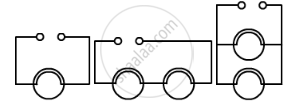
(a) In which circuit are the lamps dimmest?
(b) In which circuit or circuits are the lamps of equal brightness to the lamps in circuit (i)?
(c) Which circuit gives out the maximum light?
Advertisements
Solution
(a) The lamps will be the dimmest in the series circuit (ii) because the voltage will be divided between the two lamps.
(b) In circuit (iii), the lamps will be as bright as in circuit (i) because circuit (iii) is a parallel arrangement. In a parallel arrangement, the voltage remains the same.
(c) Circuit (iii) will give the maximum light as circuit (iii) has a parallel arrangement. A parallel arrangement offers less resistance and thus circuit (iii) will give more light.
APPEARS IN
RELATED QUESTIONS
Which particles constitute the electric current in a metallic conductor?
Which of the following equation shows the correct relationship between electrical unit?
1A = 1C/s or 1c= 1A/s
If 20 C of charge pass a point in a circuit in 1 s, what current is flowing?
If you were going to connect two light bulbs to one battery, would you use a series or a parallel arrangement? Why? Which arrangement takes more current from the battery?
Calculate the effective resistance between the points A and B in the network shown below in Figure 8.45
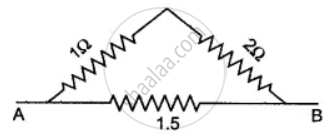
The work done in moving unit positive charge across two points in an electric circuit is a measure of
Define the following:
Semiconductors
An electric kettle has a heating element which is rated at 2 kW when connected to a 250 V electric supply. Calculate the
(a) Current which flows in the element when it is connected to a 250 V supply,
(b) Resistance of the filament,
(c) Heat produced in 1 minute by the element,
(d) Cost of running the kettle for 10 minutes a day for 30 days of the month, at the rate of Rs. 3.00 per unit.
A wire is passed through a piece of cardboard as shown in fig .. An electric current flows vertically down the wire and then flows back up. The two sections of the write are observed to repel each other.
(a) Wi th the aid of a diagram, describe how you would plot the magnetic field lines on the card .
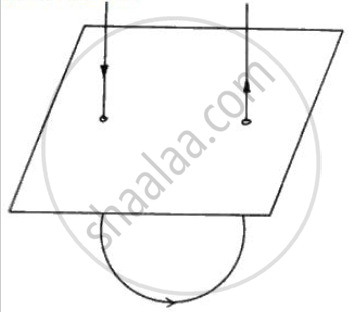
(b) Sketch the magnetic field patterns around both the sections of the wire. Use your sketch to explain why the two sections repel each other.
(c) The repulsive force between the two sections is small. What changes could be made to increase it?
1 kWh = `(1 "volt" xx 1 "ampere" xx "_________")/1000`
An electric bulb is rated at 220 V, 100 W.
- What is its resistance?
- What safe current can be passed through it?
Explain, why the potential difference across the terminals of a cell is more when the cell is not in use than it is when the cell is being used.
Which part of an electrical appliance is earthed?
Name any two devices, which are working on the heating effect of the electric current.
Electrons in a conductor move from:
A switch in an electric circuit is used to:
